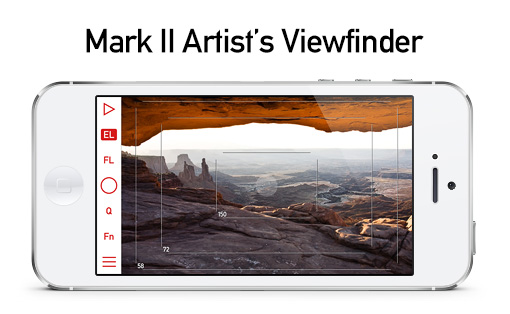
Mark II Artist’s Viewfinder 5.0 Available

Version 5.0 of my Mark II Artist’s Viewfinder app is now available on the App Store. It took quite a bit longer than I first planned, but if you look at the sheer number of new stuff, you’ll understand why. More work went into this update than it took to develop the original version 1.

I wrote about the black & white mode and exposure compensation, and the question of RAW capture in former posts, now it’s time to reveal everything else. I’ll touch a few new things in this post, and highly recommend to take a look on the complete list in the release notes. And pay attention to the “Changes” section.

Quick Control Screen

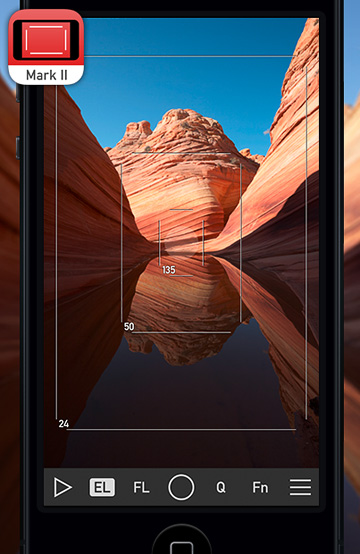
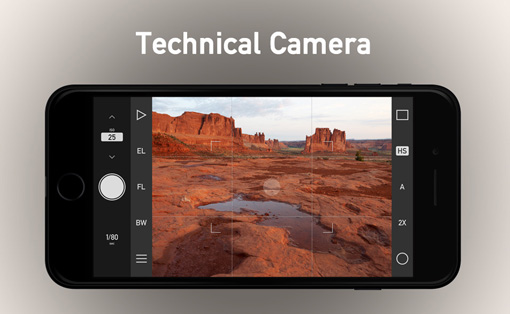
The are a few subtle visual changes to make it less cluttered, and to make room for two new icons. The half dark/half light icon in the upper right toggles black & white mode. The 2x icon switches to the telephoto camera if you have an iPhone 7 Plus. The telephoto camera and wide converter use are mutually exclusive (as one would logically expect).

Icons for parallax correction/shift simulation and aspect ratio changing are now white when a non-default value is set for these (in the above example I set the 5DS R virtual camera to 16:9 aspect ratio).

Album -> Catalog

We had to rename the Album to Catalog to avoid a name clash with the thing that Apple calls an album in the Photos app. Now ours is named Catalog, since it would be extraordinarily hard to convince Apple that they should change…

And while we are talking about the Catalog, there are performance improvements here and there, meaning that an update may be required to the new format. The app automatically detects if this is the case, and will update the Catalog automatically.

Availability

This is a free update for existing Mark II Artist’s Viewfinder owners. New user can purchase the app from the App Store.

We offer upgrade bundles for former Viewfinder Basic/Pro/Cine edition owners, so they can upgrade for a reduced price.

The Viewfinder Handbook was also updated to cover all the new features.

Rosette Nebula

Opportunities for astrophotography are few and far between: one needs clear, Moonless, windless nights; something interesting to shoot and a couple of hours spare time. I had no such opportunity for more than a year, and was keen to try a few new pieces of gear I got in the meantime.

Rosette Nebula

Rosette Nebula

The above image was the first light for my 5DS R (performed very well, it seems to be sensitive to hydrogen alpha wavelength range without the overly reddish appearance of astro converted cameras), 500mm f/4L IS II and the IDAS LPS-D1 light pollution suppression filter (did an admirable job – the above image was shot from our backyard in the countryside). Well, I would expect this level of performance from a filter costing over 250 Euros in 52mm size…

A stack of six exposures, 4 minutes each with another 4 minutes for the dark frame subtraction. 4m was the upper limit dictated by tracking precision that night (even 5m exposures were not skyfog limited). Had to throw away another four frames because of wind gusts. Shot at ISO 1600. The frames were converted in Capture One 10 (moved to C1 from DxO Optics Pro because I get much more details this way) and then processed in Photoshop.

All in all, I’m very satisfied with the result and looking forward for the next opportunity.

Mark II Artist’s Viewfinder 5.0 is Coming

The biggest update to my Mark II Artist’s Viewfinder app since its introduction three years ago is around the corner, so I’m going to post quite a lot about the new features. Let’s start with what I consider the most important: black & white mode.

The new black & white mode and exposure compensation in action.

The new black & white mode and exposure compensation in action. Click the image for larger view.

Luminance only black & white

The ability to view in black & white was the single most requested feature – so here it comes. It works by showing luminance information from the scene (just like when you convert to Lab in Photoshop and turn off the a and b channels leaving just L). There’s a new button on the Quick Control Screen to switch it on or off, and of course you can assign this function to the Fn Key (or to the EL/FL override). It’s that simple. But there’s more… The app now applies both the black & white conversion filter and wide converter distortion correction to the saved high resolution JPGs, not just to the preview image!

Exposure compensation

Since day one there was the EL key to cope with difficult lighting conditions, but now you can also set exposure compensation. Tap the main screen until the number right to the AF/AE point lights up, and then slide your finder up and down to set the actual compensation. You can set it in third stop increments. When you finished, the compensation number on the screen will become transparent. To quickly reset compensation back to 0, press and hold the screen for a second.

— ooo —

This is just two of the 18 new features version 5.0 will bring to the table – more on the remaining 16 in later posts :)

When and for how much?

Version 5.0 will be released soon. It’s feature complete at the moment, but needs to pass testing, validation and Apple’s review. It will be a free update for existing Mark II Artist’s Viewfinder users! But with the release we’ll increase the price slightly, so it’s worth buying it now and get the free update later on.

Why iPhone RAW is a Big Deal

iOS 10 brought the capability to get the RAW image data from the camera and save it as a DNG file. It elevates the quality of iPhone images to a whole new level (for those who care). The following image tells it all.

Click the image for actual pixels display on non-Retina screens

Click the image for actual pixels display on non-Retina screens

On the left is how the iPhone renders the image, on the right my version converted from DNG and tweaked to taste in Capture One. Both show the actual pixels (100% magnification). Red areas are the overexposed parts. The images were captured as RAW+JPG in the upcoming Mark II Artist’s Viewfinder 5.0, so they represent the exact same moment.

With shooting RAWs you can avoid most of the pitfalls of iPhone image processing (I know them from experience):

  • Over-sharpening, which ruins images with already high contrast edges, such as tree branches against the clear sky.
  • Excessive noise reduction – usually on an unnecessary level, even at ISO 25. You know, the blotchy look at 100% which looks downright ugly.
  • Unrealistic color. Apple processes the images for punch, which is good for making your friends envious on social networking sites, but is a problem when you want to actually use them (the images, not your friends) as real photographs.
  • Sometimes overdone light falloff correction. You know, when the sky is brighter in the corners than in the center.

You also get more headroom for recovering overexposed areas (they are also better by default because of the lower contrast), but on the other hand you need to correct corner light falloff by hand.

To my eye the difference is so large that I won’t use JPGs any more when I’m photographing with the iPhone (which happens a lot, since it’s always in my pocket). No, they are not challenging DSLR (or even large sensor point and shoot) quality, but are way more usable than the JPGs.

A Year with Zeiss Lenses

More than a year had passed since I started migrating to Zeiss lenses – and I still couldn’t be happier. This, together with the Canon 5DS R completely transformed how I approach my subjects. The resulting files reflect what I see and how I see it. Every time. No additional frills that need to be edited out in post.

Fall Morning

Fall Morning

No matter if I work slowly and deliberately under a dark cloth, tethered to a MacBook Air, or – as it was the case with the above image – shooting handheld from a moving boat. The images are always stunning. I’ve never been so satisfied with any photographic equipment. These words shouldn’t be taken lightly – I’m an extremely hard-to-please man.

The only thing I miss with this setup is movements. A few degrees of tilt/swing here and there, plus a couple of millimeters rise/fall/shift could save the day sometimes. Well, if you think that I’m exploring the possibilities in this area, you are right. But more on my findings later.

Stranded and Breaking Up

The photo below is a good example of when endurance pays off. Following a rather spectacular sunrise weather slowly turned miserable. After a while my shooting companions gave up, and I was walking the beach alone in the cold drizzle. Camera and lens wrapped in a plastic bag. Wiping water off the LEE Big Stopper every 30 seconds or so.

But suddenly everything came together. Forms, colors, patterns. I’ve explored this composition quite a bit, taking roughly 20 frames with slightly different angles and of course to have several wave formations in the background to choose from.

Stranded and Breaking UP

Stranded and Breaking Up

And yes, a cup of hot tea in the car was priceless… Photographed with the Canon EOS 5DS R and Zeiss Apo Sonnar T* 2/135 lens.