Practical Limits of Enlargeability

I have been asked numerous times about how big a print can be made from a digital image. Up until recently, the answer was quite easy: one would need a 200 PPI or higher resolution image for matte papers and 210 PPI or higher for semigloss surfaces. Canvas is a much more forgiving medium, one could go much lower with careful processing. My biggest enlargement, from a 4.5 megapixel original, was printed on Hahnemühle FineArt Canvas in 36 x 100 cm size. This was shot with an 1D Mark II, so this is a 35x enlargement. The print was made at 90 PPI. Yes, this was a result of several hours of careful editing and a matching media choice.
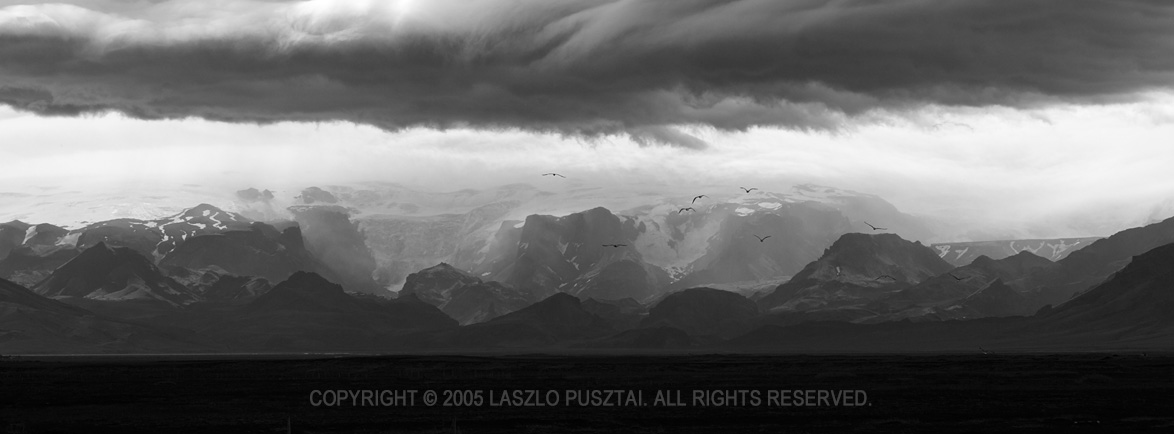
This is a crop from a 8MP image. The biggest print that still looks great is 38×100 cm. But this is an exception in enlargeability, not the norm. Subject matter really helps here.

Of course high resolution is a must for hyper-realistic prints. Posters can be made at much lower resolutions. But I’m not interested in making posters at all. I even wrote an app (PrintCalc), that can calculate all this resolution requirement stuff for you.

To put it another way, digital prints were limited by the sensor’s resolution.

In these days, however, we face another limits. Diffraction, depth of field and lens quality. Let’s take a Canon 5D Mark III for example. The full frame sensor at 22MP starts to get diffraction limited below f/10. The 7D at 18MP is visibly diffraction limited at f/8. The problem is worsened if you want big prints. One often overlooked attribute of depth of field is that it gets shallower as you make bigger enlargements. But you can’t stop down to increase depth of field at your will, because diffraction kicks in. This might, or might not be a problem depending on subject matter.

For landscapes, diffraction puts an upper limit to practical enlargement ratio. You can only go larger if you use a bigger sensor. For other subjects, where you can shoot at wide apertures, this isn’t that big of a problem, so you are limited by the number of pixels. Speaking of the number of pixels: DxO’s new “perceptual megapixels” ranking is a good indicator what kind of resolution a lens can give you. You can increase sensor resolution, but the lens will still be a limiting factor. Think about this perceptual megapixel number as the one you can use as the basis of maximum print size calculations. Look at the best lest they tested to date: Canon’s EF 300mm f/2.8L IS II USM. It can fully utilize a 21MP sensor, but you’ll end up around 14MP on a 18MP APS-C sensor (the 7D).

So it’s easy to see that blindly increasing sensor resolution in any given format above lens capabilities and so much that is severely affects usable apertures is not the smartest thing.

What is that practical limit? I found that about 20 times enlargements (in linear dimensions) make great hyper-realistic prints, keeping ill-effects at a minimum. This translates to about 50 x 75 cm (20 x 30″) for full frame and 30 x 45 cm (12 x 18″) for APS-C. Regardless of megapixels. Of course you’ll need to hit the 200-210 PPI minimum, which is about 11-12 MP for APS-C and 23-24 MP for full frame. But increasing the sensor’s resolution beyond these points will only allow to reap the benefits of oversampling, and not really allow bigger prints at the same quality (not to mention increased storage requirements).

Want bigger? There’s only one way with today’s technology: increasing sensor surface. Basically we have to paths in pursuing bigger recording area:

  • Go medium format. Digital 645 will give you images that can be printed at 80 x 110 cm (30 x 40″) – from an 50 MP or larger file. This costs a lot.
  • Stitch several images together. I routinely use my TS-E 24mm lens to get images equivalent in size to a medium format sensor (36 x 48 mm). This is more work, but at the fraction of the cost of medium format.

20x enlargements are far better than you could achieve (in high quality) from film. This is actually at least one format size better (full frame 35mm beating 645). But remember that every technology has practical usage limits, and make them work for you – don’t blindly believe manufacturers’ marketing stuff.
Inside Out

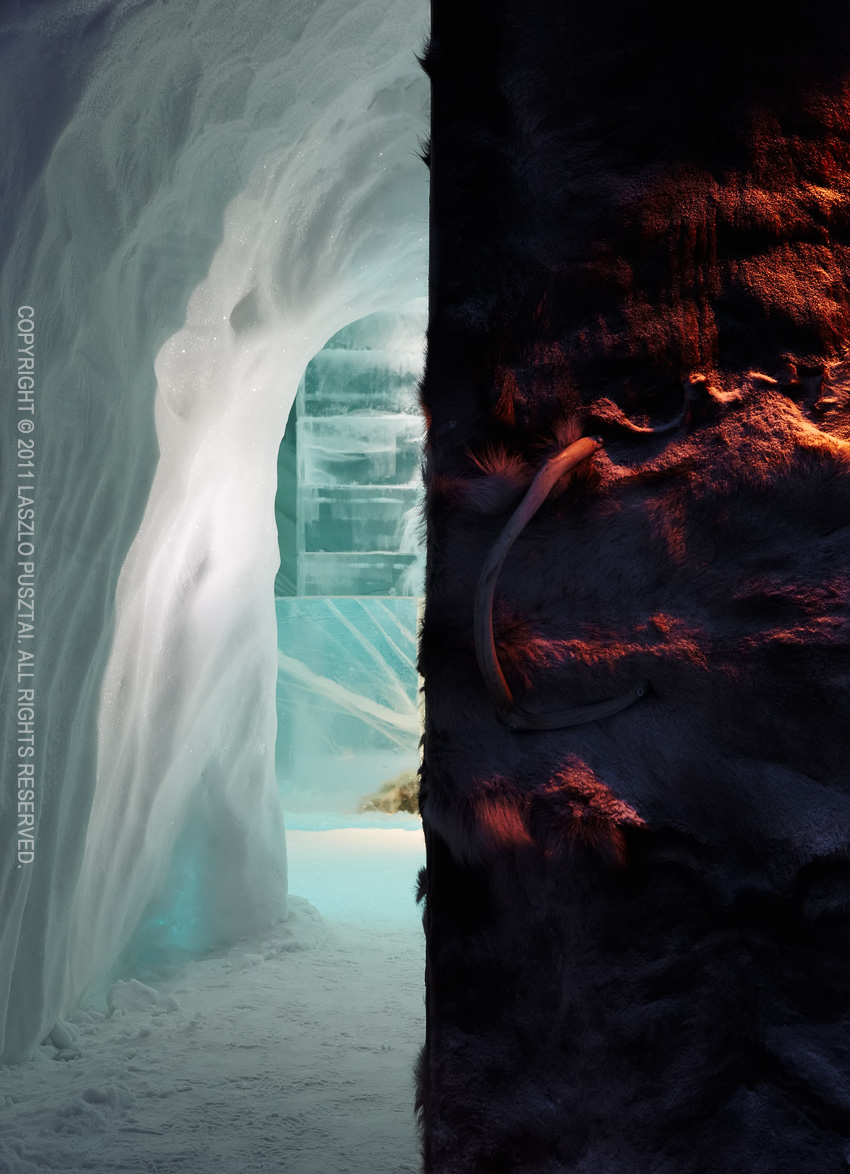
During winters warm colors and the warmth of fur is associated with the inside of a house, while cool colors and ice means the freezing, hostile world outside. This image was taken at the front door of the Ice Hotel in Kiruna, Sweden. I love the way it reverses the inside-outside association. Happy holidays!

Inside Out

“Damn, I Would Need a Tilt/Shift for That”

I can’t remember how many times I had to say the above… Until my 24mm TS-E lens arrived, of course. This is a kind of scene that you can’t photograph without such a lens (OK, you can do that with a 2m ladder). The other option would be perspective correction after the fact – losing substantial amount of resolution. But for a stunning 40 x 60 cm print you need the resolution.

Because of the slight overexposure I employed here (to add to the glowing fog feel), there was some cyan CA at high contrast edges along the top 1/5 of the image (the lens was shifted a lot), but nothing that can’t be corrected quickly in post.

I must admit: the TS-E 24 is my favorite landscape lens.

The Dividing Line

First Flight Shooting with the 5D3

Yesterday evening I went out to Lake Tisza for a two hour flight shooting test. Courtship feeding was in progress these days in the whiskered tern colony and I thought that that could be a good test for auto focus capabilities, and a chance for me to learn to use the new AF system.

I’ve used two lenses: a 500mm f/4L IS USM with the 1.4x II extender, and a 400mm f/5.6L USM. Both lenses had an 600EX flash attached to a bracket with a Better Beamer – for just a gentle touch of fill light. I shot handheld with both lenses. Yes, it is not the funniest thing to follow fast moving birds with about 6kg of glass and metal, but wanted to know how it feels with the smaller body of the 5D3.

Self-Shadow

The new AF system worked quite well. It was as good if not better than the aging system in my 1D Mark II. Coming from the 1D2, the ability to show the active AF points in the finder was a real boon – I could instantly refocus when the system catched the otherwise busy background.

I was surprised that I did not feel the need for the grip when shooting with the 500mm. Although the 5D3 is not that much bigger than the 5D2 was, it fits my largish hand much better. I was able to grip the body securely and maneuver the 500mm lens with it. I was even more surprised that with the 400mm I could use the grip – the rig felt somehow nose-heavy. Or I just missed the hand strap. This point needs more testing. But at the moment I think I will work without the grip for at least a month or so.

Images are first class, there’s nothing to complain about them. I really love the huge 22 megapixel files – I can crop them as needed later without risking my usual A3+ sized bird print quality.

For those interested in the f/8 thing. I started to avoid shooting with the 2x teleconverter since the 1DX specs arrived – just to see if there’s anything I miss with it. Actually I have gained a lot – better image quality (the 2x II is quite a lemon). I also had to push myself and move closer to the birds. It proved to be great fun – the closer you are the more you became a part of their lives. Bottom line: don’t feel a burning need for the f/8 focusing capability at the moment. I just let those images that would need the 2x go.

Courtship Gift

Regarding the bad things. There a few of course. The most irritating of them is the auto brightness control algorithm. On several occasions the screen remained so dark that I can’t see a thing on it (it was golden hour, so the sunlight was quite muted). When I pressed the play button sometimes brightness came back. So I ended up turning off the auto thing and controlling brightness myself.

Another observation that makes me sad is the inability to judge sharpness from the LCD. I do AF microadjustment check/recalibration before each shot for the actual working distance. But frankly I was unable to judge where the focal plane is without cranking up JPEG sharpening seriously. But that have a negative side effect on the histogram and blinkies. I would like to see the LCD image properly sharpened for the camera’s display (or even a custom function that would allow slightly over-sharpening it so that one can judge sharpness much easier) without affecting the JPEGs and the histogram. Maybe in the 5D4 or 5…

All in all I really love the 5D3. It is a joy to work with this camera. Is it perfect? Far from it. But if I treat is as a tool then I’m sure it will produce some great images in the upcoming 3-4 years.

Climbing the Stromboli

In early June we spent a week long holiday in Sicily. The highlight of the trip for me (both as an experience and as an opportunity to take images) was the ascent to the craters of Stromboli.

We arrived to the island late afternoon, and our host mentioned that we can climb the volcano if we want with the last group that day. This was a fascinating opportunity – to climb the mountain in the best light. The funny thing was that we had no proper equipment – we just grabbed some shoes and pullovers. I always had a Petzl headlight with me, but the girls hadn’t, so I rented a couple of lights and joined the – mostly – properly equipped group.

I had only my vacation equipment with me – a Canon 5D Mark II with three lenses: a 24mm f/2.8, an 50mm f/1.4 USM and a 100mm f/2 USM. I used the 24mm almost exclusively – really like that little lens.

There We Go

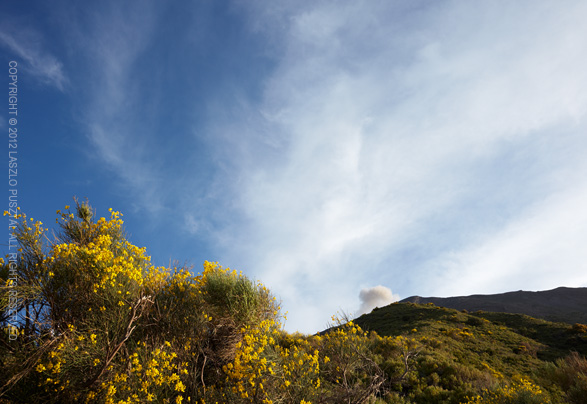
Stromboli is an active volcano and it’s not shy to show off. You can see the ash clouds it pumps to the air from the beginning of the trip.

Speaking of the trip itself. The first 400-450m of the ascent is relatively easy. There’s vegetation everywhere, and you walk on soil. After our second break, at around 450m height, things start to get tough. There’s no vegetation from that point, just ash, rocks and wind. Wind that can be furious at times. This was the time to put on all the warm clothing and prepare for another 1-1.5 hours of walking on steep ash-covered slopes.

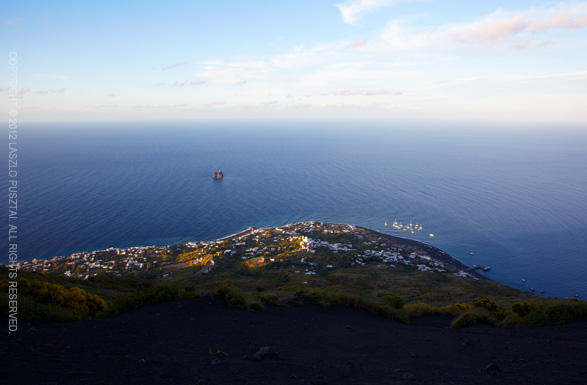
But the vistas were incredible.

Looking Back at the Village

So much, that I – being the only serious photographer – usually tailed off the group. Fortunately (or not) I had no tripod with me, so composing images was quite fast compared to my usual working methods.

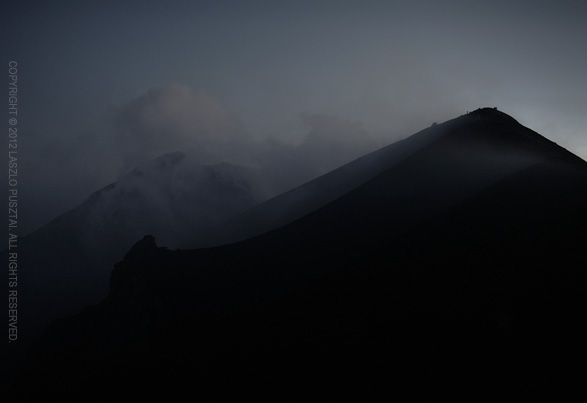
As we approached the last slope, the view behind us turned incredible. Some ash clouds from the crater just floated above the tip of the volcano’s shadow – as if the shadow created them. Took some 10-15 images of the shadow from different angles and turned towards the final slope.

Smoking Shadow

Just about a minute before we reached the flat region before the summit, the Sun dipped below the horizon. Lights were still great, but as the night started to fall a foreign, surreal and hostile world started to materialize in front of my eyes. Squat down behind a rock, trying to stabilize my camera (and protect it from the furious wind).

The following minutes touched me deeply. I felt completely alone, with the wind, the smell of the volcanic fumes and the approaching darkness. The resulting image is my favorite from the entire trip.

Darkness Approaching

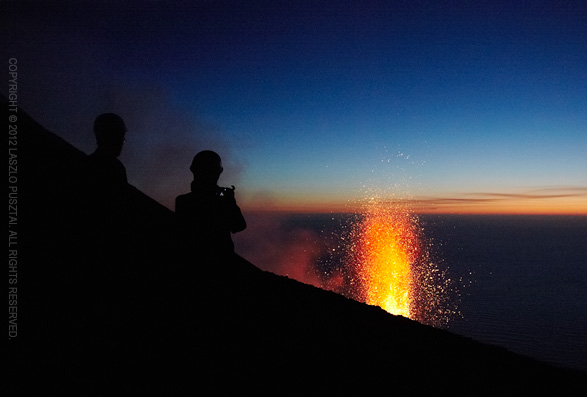
Then I heard a huge explosion. This was a complete surprise for everyone. The volcano shot up a huge fountain of molten lava. I had little time to change settings on my camera, so run up to the edge of the wall separating us from the craters – taking pictures on the way.

The following one is the second frame from the series. This one with my fellow group-mates is way stronger that the subsequent ones showing just the volcano and the lava.

The First Surprise

We spent a short hour on the summit, witnessing 3 or 4 eruptions. I really missed my tripod at that time.

The descent was easier physically but harder ash-wise. We literally “skied” down on ash-covered slopes. We had to unload the ash from our footwear twice during the downward part of the trip.

We heard several eruptions during the night, and went down to the port early next morning. The last frame was taken with the 100mm f/2 lens.

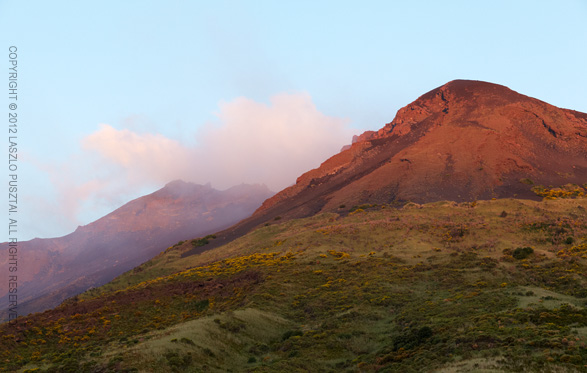
First Light

I definitely want to go back to photograph Stromboli – but that time with real photographic equipment (which dictates real climbing equipment because of the sheer weight of my camera bag).