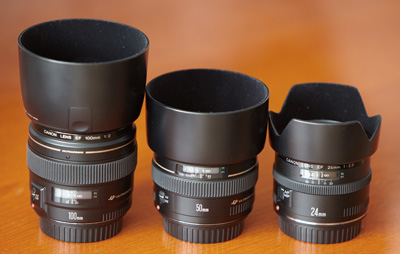
Canon 100mm f/2 USM, 50mm f/1.4 USM, 24mm f/2.8
My fully loaded camera bag is around 16kg (without the 500/4). So I started a “project” to reduce its weight substantially. The goal is to shave off 3kg. The other reason behind buying the non-L glass you see on the right was that I needed a lightweight travel kit. After contemplating a lot and considering even the Sony NEX-7 and the Fuji X-Pro 1, I had decided to go the most cost effective way: get some good primes for my 5D Mark II.
I had spent a weekend on reading reviews, analyzing resolution and distortion charts. And a strange thing started to materialize in front of my eyes. I’ve found three Canon primes that promised stellar image quality, low weight and low price tags. So I ordered the 24/2.8, 50/1.4 and 100/2 trio (of course with the optional lens hoods).
First arrived the 24mm (at the same day when Canon announced that this lens is discontinued and will be replaced with a much expensive IS version). I was surprised how sharp this lens was, blowing away my two L zooms that cover that range, and providing better center sharpness than the marvelous TS-E 24 II.
A few days later the 50mm arrived. Mounted it on the 5D II and compared it against my 24-70/2.8. It was no contest. The 24-70 was not even in the ballpark. Immediately replaced it with the 50, reducing my bag’s weight by about 600g.
The 100 produces much less shock than the other two. It is just a great lens (although I still prefer the color rendition of the 70-200/2.8 IS). Compared it with a friend’s 100/2.8 IS Macro, and at f/8, although less contrasty, it was on par with the macro lens (in the corners the little 100 produced better image quality).
These primes cost less together than a 24-105 f/4L lens and image quality at modest apertures (f/4-f/11) is much better in almost all aspects (avoid shooting towards the Sun with the 24…). Or to put it another way: I can break or otherwise ruin any of these three times to arrive at the price point of an L counterpart.