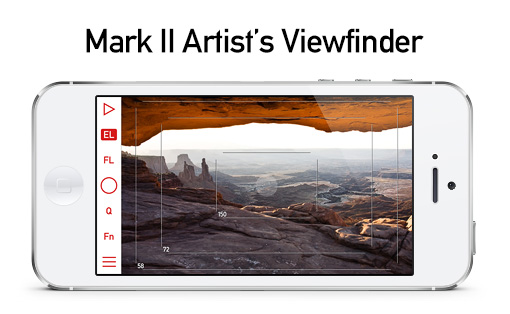
Mark II Artist’s Viewfinder Released

avf2iconI have been silent for the last weeks for a reason: we were working hard to bring the Mark II Artist’s Viewfinder out.

And now I can proudly announce that a few minutes ago it went online on the App Store, so you can go and grab it. :)

The usual announcement stuff will come next week, but you can find most of the info on the app’s microsite right now.

One more thing…

Courtesy of ALPA of Switzerland, the eFinder Tools are now part of the Mark II – no additional in-app purchase necessary. Although the parallax/shift tool is still supports ALPA cameras only, you can freely use the super precise (1/10 of a degree) 3D level with any camera. I might be biased, but for me it leaves the 5D Mark III’s two-axis level in the dust.

Wide Converters in Mark II Artist’s Viewfinder

Today we announced the beta of Mark II Artist’s Viewfinder. With the Mark II we took a new direction on how we handle wide converter lenses. In the past we just multiplied frame line positions with the wide conversion factor, not doing anything about the optical aberrations of the converter lenses. And believe me, they have many. Distortion, chromatic aberration, centering errors, you name it, the converter has it.

Most of these aberrations can be safely ignored as nobody takes real images with a viewfinder. One of them however, distortion to be exact, is a huge problem. It enlarges the center portion of the image and compresses the edges, making the effort of precise frame line positioning futile.

Given the immense power of today’s iPhone GPUs, we set out to get rid of wide converter distortion forever. And I’m pleased to tell you that we succeeded: the Mark II sports real-time distortion correction! Following is an example of its power.

Before and after distortion correction

Before and after distortion correction

ALPA’s ACAM Super Wide Converter exhibits about 11% barrel distortion (on the left). Which is completely eliminated in the Mark II (on the right). Yes, resolution suffers, but it is pretty much enough for viewfinder use. There’s also some darkening on the lower left corner (the converter vignettes heavily and asymmetrically on the iPhone 5s – which isn’t a big issue after the correction).

With the corrected view we can simulate super-wide lenses, which is a blessing for landscape and architecture photography. But I also regularly use the ALPA’s iPhone Holder together with the ACAM SWC as a viewfinder for my Canon TS-E 24 pano stitches. Here’s a screenshot I took on my old iPhone 4 while composing The Circle.

IMG_1631

Composing a stitched pano

Note that the iPhone 4 isn’t fast enough to do the correction at full Retina resolution – all other supported iPhones (4S/5/5S) are.

At launch we’ll support ALPA’s ACAM SWC, but the lab and the measurement technology is ready, and we’ll add adapter/device combinations as we measure them. On the device front, iPhone 4/4S/5/5S are supported.

So if you regularly shoot wide, or want to get a tool that allows you to visualize tilt/shift stitches, then head to the Mark II’s site and sign up for a beta. Seating is limited, so hurry! Then it’s time to order an ACAM SWC from ALPA.

ShutterCount 1.1 with New Camera Support

ShutterCountIcon2xShutterCount 1.1 is now available on the Mac App Store.

In this release we have added support for Canon EOS-1D Mark IV, EOS 50D and EOS 550D / Rebel T2i / Kiss X4 cameras.

The complete list of supported cameras is available on the product page.

Also new is a FAQ page, which is available from the app’s help menu, or directly by clicking here.

ShutterCount for the Mac Released

My newest Mac app, ShutterCount displays the number of shutter actuations (the shutter count) of your Canon EOS digital camera. The shutter count is read directly from a USB-connected camera, and thus provides accurate numbers that are not attainable with simple EXIF-based methods.

ShutterCount

Simple is that. You can skip the trip to Canon for a reading, and you don’t have to pay every single time you want to check the count. Note however, that video clips recorded are not included in the number. For a separate mirror movement reading (that includes videos) you should still have to visit a Canon service center.

Speaking of money, you can grab the app at a special introductory price from the Mac App Store. This promotion runs until the end of October.

Supported cameras are the following:

  • Canon EOS-1D X
  • Canon EOS 5D Mark II
  • Canon EOS 5D Mark III
  • Canon EOS 6D
  • Canon EOS 7D
  • Canon EOS 60D
  • Canon EOS 70D
  • Canon EOS 100D / Rebel SL1 / Kiss X7
  • Canon EOS 600D / Rebel T3i / Kiss X5
  • Canon EOS 650D / Rebel T4i / Kiss X6i
  • Canon EOS 700D / Rebel T5i / Kiss X7i
  • Canon EOS 1100D / Rebel T3 / Kiss X50

Mark II Artist’s Viewfinder Announced

The worst thing in developing cutting edge software is that you can’t share your excitement the moment you achieved something great. And by the time you can publicly talk about it the excitement is long gone. So this is a special moment for me: talking about an app that’s still in the works, although the major pillars are already in place. And this app is the successor of our Viewfinder family, the Mark II Artist’s Viewfinder.

vf2header2

There isn’t a single piece of code that we haven’t touched during the making of the Mark II. Everything is modernized, made simpler, faster, and better – and have its design updated.

The flat, simple design iOS 7 brought resonates with me deeply. So my goal was to create something that looks every bit as great as it works. I can go on for hours telling stories, and probably will during the coming weeks (just keep in mind that finishing the app is my top priority right now).

For now I’d like to present you a list of what’s new (from the announcement press release):

  • By utilizing the Retina display, frame lines are now 1/3 of their former width. This, along with their increased opacity and contrast, results in drastically improved visibility and reduced interference with the composed shot.
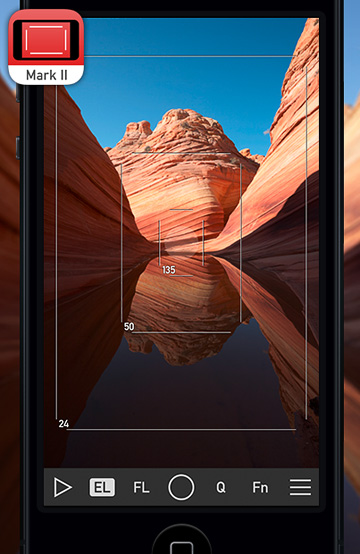
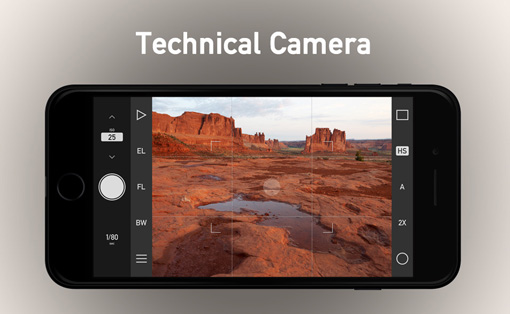
  • The main screen now handles like a camera, complete with auto-exposure lock, auto-focus lock, AF confirmation beep and single shot/continuous AF support. A new Quick Control Screen for accessing frequently needed functions and a customizable Fn Key make the new app more productive.
  • The Mark II can save clean full-resolution photos with location and simulation metadata, so it can be also used as a regular camera.
  • The number of simulated equipment setups (now named “virtual cameras”) was increased from 4 to 20. The number of custom cameras and backs was increased from 5 to 20 each. The number of custom focal lengths per virtual camera was increased from 3 to 20.
  • A new menu system is provided for configuring non-simulation parameters of the app.
  • Track logs can be managed from within the app, with no need to connect to a computer via iTunes File Sharing.
  • Quick Lens Change for quickly modifying the lens list of the active virtual camera.
  • Automatic, configurable length image review (can be also turned off).
  • All features and cameras of the former Pro and Cine editions are now available in a single app, no additional in-app purchases needed

And were are already working on cool things that aren’t even on the list ;)

So make sure to visit and keep an eye on the app’s new microsite, available at: http://www.artistsviewfinder.com.

Focus Bracketing Comes in Kuuvik Capture 1.1

kc-focus-bracketToday I practically finished the focus bracketing feature in Kuuvik Capture. Of course it has to pass our rigorous testing procedure, but the features are considered final.

Speaking of the features. You can drive focus starting from either the closest or from the farthest point, in small/medium/large sized steps. What those steps mean is camera body and lens specific (a totally arbitrary value actually), so you have to test it before starting the bracket. Hint: Command + arrow in live view mode drives focus by small steps, while Command + Shift + arrow drives it in medium steps.

You can expose up to 30 images in a focus bracketed sequence. It can also be combined with mirror lock-up and the intervalometer, as usual. At the end of the sequence we try to focus your lens back to the starting position, but don’t rely on it if you need accurate positioning – some lenses are really crappy in this regard and are unable to drive focus by the same amount back and forth.

kc-15-bracketWe have also changed the maximum number of shots you can expose in other bracketing modes to 15. As you can see on the bracketing monitor, this number is usually more than the exposure range your camera is capable of, but some of you requested it, so we added it.

Version 1.1 is in private beta right now, and it is planned to be release early July. It will be a free upgrade for current Kuuvik Capture users.