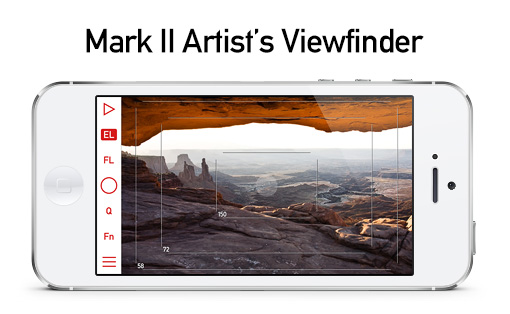
Mark II Artist’s Viewfinder 7.6 Released

Version 7.6 of the Mark II Artist’s Viewfinder had been released about a month ago. It brings the usual updates for supporting new devices and new operating systems.

My previous post on Technical Camera updates – with the exception of highlight alert changes – also applies to Viewfinder.

But this time I’m bringing some sad news as well.

ALPA eFinder II Is No More

You may have noticed that we put eFinder II updates on hold about a year ago: we were waiting for ALPA to decide whether they are still interested in providing funds for the development of the ALPA-branded variant of our Viewfinder app.

The decision had been made recently: the ALPA eFinder II app is now officially discontinued and had been permanently removed from the App Store.

Important to note that this does not affect the ALPA eFinder Tools included in the Mark II Artist’s Viewfinder: the 3D level and the parallax/shift correction tool. These tools, or some variants of them, will continue to be available in the Viewfinder app for the foreseeable future.

Technical Camera 2.6 : Ultra Wide Zooming, Camera Button, Highlight Alert

The latest update to our Technical Camera app had been released about a month ago. Besides the usual device support updates (for new iPhones and iPads) and iOS 18 related stuff (dark mode icons and so on), there are a couple of things I’d like to talk about.

Ultra Wide Zooming

We use our own ultra wide camera distortion correction solution as it is far superior to Apple’s built in correction. For one, it allows precise simulation required in the Mark II Artist’s Viewfinder, and is behind the Framing Previsor in Tech Camera.

There is one limitation with the better correction, however: if the device’s ultra wide camera is way too distorted, then we can’t do the correction when one zooms in.

Fortunately the latest incarnation of Apple’s ultra wide cameras (in the iPhone 14 Pro, 14 Pro Max, 15 Pro, 15 Pro Max, 16, 16 Plus, 16 Pro and 16 Pro Max) are much better in this regard and thus we can do distortion correction when you zoom in.

Given the very short minimum focusing distance of these ultra wide cameras, this makes a formidable macro shooting solution.

Note however, that zooming is only available with JPG captures. For RAWs, you’ll have to crop afterwards manually.

Camera and Action Button Support

iPhone 16 models introduced the Camera button, which I honestly regard as a marketing gimmick. It reminds me of the Canon EOS R’s ill-designed touch bar… Since we have much better user interface solutions for camera control than this, we are not going to support it except for one thing: capturing images.

Speaking of initiating captures with hardware buttons, if you run iOS 17.2 or later, the Action button can also be used for this purpose. The only requirement is that you must assign the “Open Technical Camera” shortcut to it. But with this assignment, the Action button can be used to launch the app, and subsequently take pictures – without lifting your finger from the button. Pretty neat.

Highlight Alert Adjustment

There is a significant step back with recent iOS versions regarding non-HDR captures: the system lowers the dynamic range by about 10%… For no reason… It just stared to happen with newer iOS versions on more and more devices.

So since this is the new norm, we adjusted the highlight alert’s cutoff point to reflect the lower maximum. It’s sad enough that non-HDR dynamic range is reduced by iOS, but at least you can now see where will the system prematurely blow the highlights.

Capture Button Bonuses

One more thing. There are two minor, but nice things regarding the on-screen capture button. First, it has haptic feedback in case you enabled haptic feedback in both the app’s menu and on your phone in general.

Plus, try what happens if you disable Other Sounds in the app’s menu! Yes, you no longer have to put your phone or iPad into silent mode to avoid the ugly iOS shutter sound. Well, unless you live in Japan, where this feature is not available.

Canon EOS R5 Mark II Support in ShutterCount and Kuuvik Capture

ShutterCount 6.6 and Kuuvik Capture 6.6 had been released two weeks ago with Canon EOS R5 Mark II support. ShutterCount is the world’s first shutter count reader with support for this new camera.

ShutterCount also adds support for the Nikon Z6 III.

With that said, there’s something I have to talk about.

People tend to assume that we get cameras in advance of their official release and start banging on our doors with varying level of arrogance on day one of a camera’s availability.

Let me put this straight.

Canon does not provide us with cameras before their release. We have to cope with the ridiculous (un)availability these days, just like anyone else.

Canon also does not provide any kind of documentation for us. We have to reverse engineer new cameras, develop code for the new features, work around the myriad of surprise firmware bugs, and validate the results against our strict standards. We will not release an update until it functions properly and reliably.

Now this, ladies and gentlemen, does not happen overnight. We have to put in substantial amount of work – not to mention the money camera purchases and rentals burn.

But thanks to our decade-long expertise and advanced technologies, we routinely bring out new updates quickly after a camera’s release.

So instead of complaining about new camera support on day one, please save your energy for thank you emails when new camera support arrives.

Kwiketta 2 Available on the App Store

Kwiketta, a little utility that allows direct launching of the Intel binary of Adobe Photoshop on Apple Silicon Macs, had been released almost two years ago. It was – and still is – an indispensable tool for people still using Intel-only Photoshop plugins.

Back then, the App Store did now allow apps that only work on Apple Silicion Macs, thus we released the app as a direct download. But we asked Apple to add this feature. This request was honored recently, paving the way for Kwiketta in the App Store.

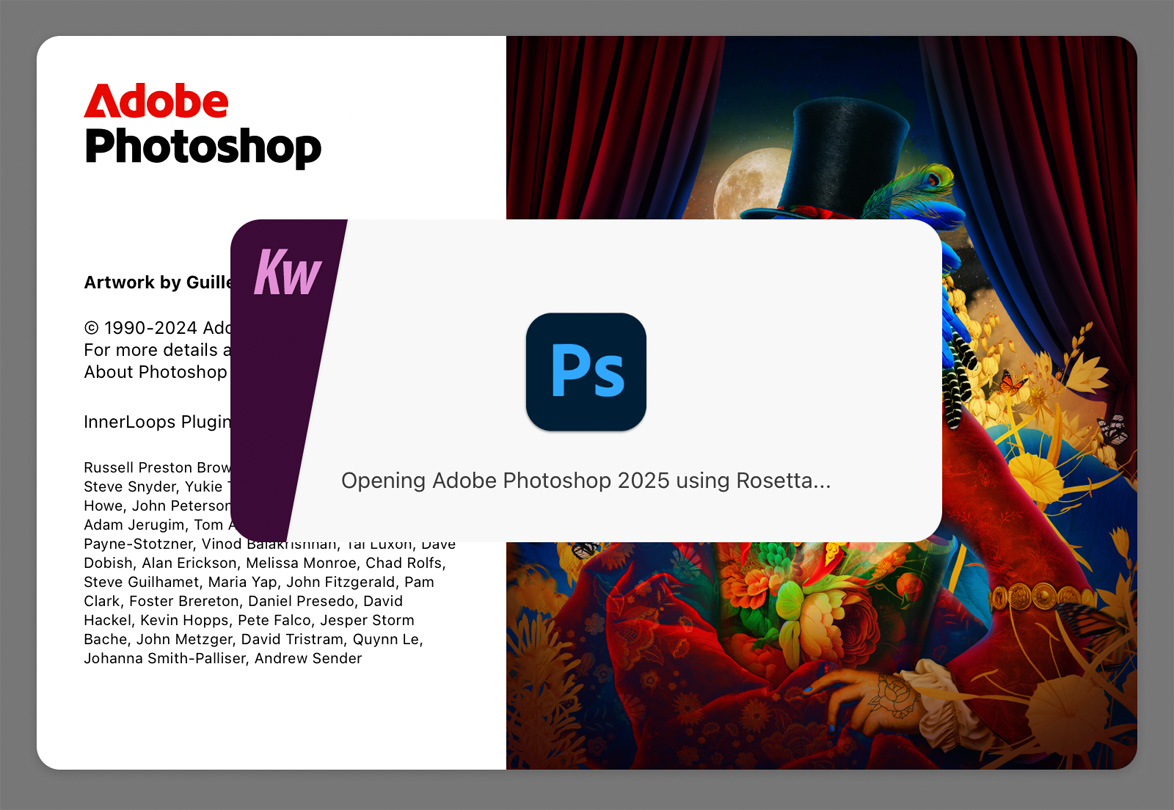
Kwiketta 2 launching Adobe Photoshop 2025

To be App Store compatible, we also had to find a way to replace the Dock Tile Plugin used for getting to the app’s settings when it’s not actually running. Kwiketta now uses special shortcuts on the Dock icon’s recent list for this purpose, available after the very first launch of the app.

Other than this, the functionality is identical to what I described in my original announcement post.

Kwiketta 2 fully supports the latest macOS and Photoshop versions.

Originally the app was coffee-supported, but we moved to the traditional upfront payment method with the App Store version. The price is still the same – around what you pay for a coffee – with a special introductory price until the end of November. Users who bought me a coffee for the original version should contact DIRE Studio for a replacement license.

Kuuvik Capture 6.5 : Download Skipping

Kuuvik Capture is used for diverse purposes and in diverse environments, in some of which long download times interfere with the photographer’s workflow. Think about transferring huge RAWs over Wi-Fi. Or a camera having USB 2.0 only. So it’s not surprising that skipping image downloads was among the most requested features.

The app already sported an option to skip downloads during sequences, and you could choose which part is downloaded if you shoot RAW+JPG, but version 6.5 takes it a step further.

The new Nothing option of the Download setting will cause Kuuvik Capture to skip every single download. Standalone captures as well as images in a sequence. It is available for RAWs and JPGs besides RAW+JPG pairs.

Use Download > Nothing to skip the downloads.

Naturally, the Download setting is now visible for all image quality settings.

You can still control sequence download skipping separately with the Do not download images captured in a sequence setting in case Download is set to other than Nothing. But in case of Nothing, the Do not download images captured in a sequence setting is automatically turned on and grayed out.

Works exactly the same way on both Mac and iPad.

A little thing, but I’m sure a lot of people will appreciate it.

Kuuvik Capture 6.5 : Unaligned RAWs

There’s a serious disease spreading across the photographic industry, and unfortunately Canon also got infected recently. I’m talking about mandatory lens distortion correction. That is, when a manufacturer instead of doing proper optical correction, decides to make it in software. Well, the lens will get smaller and cheaper to manufacture, but micro contrast and resolution will suffer heavily. I do recommend checking out Bryan Carnathan’s distortion test images and reviews for more information. He did a groundbreaking job with publishing this information. For example this is how the RF 16mm f/2.8 looks.

Note that the RAW data in RAW files is not corrected. Only JPGs – and the JPG previews embedded into RAWs. And here lies the problem. Imagine the lack of alignment between a heavily distorted RAW data and the corrected rectilinear preview on images taken with the RF 16mm f/2.8 – and how unaligned Kuuvik Capture’s RAW clipping warning layers will become thanks to this.

To add insult to injury, Canon does not put distortion correction metadata into the RAW files, so there’s no chance to correct RAW clipping warning layers in the app.

You may ask: “You have distortion correction technology in your other apps, why don’t you profile and correct the lenses yourself?” Well, even if we did, the correction we apply would not precisely match what Canon does with the embedded preview JPGs. The only solution would be to expand Kuuvik Capture into a full-blown RAW converter and ignore embedded previews. This doesn’t seem to bet a good value proposition right now…

Since I have tons of experience with software distortion correction and its negative effects on image quality, I would never buy a lens requiring software distortion correction for professional use. And recommend you to stay away from those as well.

How can you check that a lens requires mandatory correction? Go into the Lens aberration correction menu on your camera and if the Distortion correction item is set to ON and grayed out, then you’re dealing with mandatory correction.

Canon’s distortion correction setting

For RAW shooters I highly recommend to turn ALL corrections off here. You want the embedded preview to reflect what’s contained in the RAW data as much as possible, so these are all working against you.

Beginning with version 6.5, Kuuvik Capture will not load RAW data by default if it detects a distortion corrected embedded preview. It will display a warning message instead so you can know about the situation.

Of course you can override this and load RAW data regardless. There are a lot of lenses where this correction have slight effects. Or you might forgot to turn distortion correction off on your camera and still want to have a RAW histogram. The choice is yours. But you can make an informed choice.

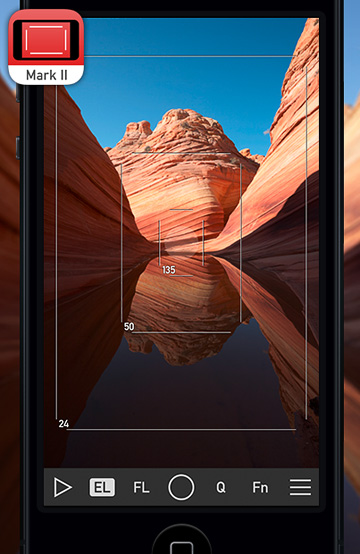
If RAW data is loaded for an image having distortion correction, the RAW histogram will be labeled Unaligned RAW so you can be aware of that RAW clipping warning layers may not be properly aligned.

You could have a situation where you have a bunch of images with in-camera distortion correction applied, and it would be a pain to override the new loading behavior manually for each one.

So we added a new preference to control RAW data loading behavior. Instead of the former checkbox, you now have three choices: Always, Aligned Only and Never. The default is Aligned Only. Choosing Always will restore the previous app behavior and load RAW data if present regardless of the preview’s distortion correction.

RAW loading behavior setting in Kuuvik Capture 6.5

List of lenses with mandatory distortion correction

As of 1/10/2024, I’m aware of the following Canon RF lenses requiring mandatory software distortion correction. Most of them exhibiting an extreme level of barrel distortion.

  • RF 16mm f/2.8 STM
  • RF 24mm f/1.8 Macro IS STM
  • RF 28mm f/2.8 STM
  • RF 10-20mm f/4L IS STM
  • RF 14-35mm f/4L IS USM
  • RF 15-30mm f/4.5-6.3 IS STM
  • RF 24-50mm f/4.5-6.3 IS STM
  • RF 24-105mm f/2.8L IS USM Z
  • RF 24-105mm f/4-7.1 IS STM
  • RF 24-240mm f/4-6.3 IS USM
  • RF-S 10-18mm f/4.5-6.3 IS STM
  • RF-S 18-45mm f/4.5-6.3 IS STM

This is brutal. Even L lenses are affected. That’s it about the “RF mount enables higher quality optical designs” promise. Oh yes, may I mention the over-the-top focus breathing of Canon’s RF lenses? Not a surprise that I’m not remotely a fan of the RF mount.

With the unaligned RAW warning, Kuuvik Capture 6.5 helps you to be aware of one more nasty reality of today’s “digital world”. A little aid for professionals striving to make informed decisions.