Kuuvik Capture 6.5 : New Video Features

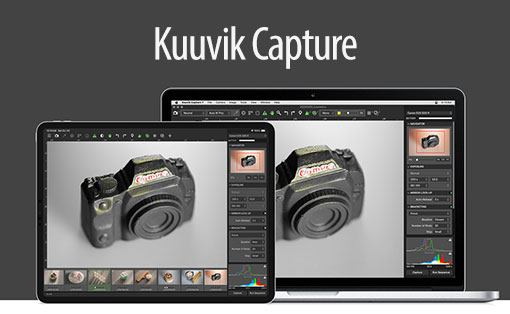
Kuuvik Capture 6.5 is now available on the App Store. This release sports a couple of features developed specifically for video shooters.

Let’s begin with the most-requested thing: audio level indicators. As you can see on the screen shot on the right, the audio meters occupy the place of the RAW histogram in video mode. We’ve put it there, because there is no RAW histogram in video mode, and because I strongly think that the image area is sacred and not willing to pollute it.

Audio metering is a complete mess on the latest Canons (R8 and such), so we did stick with the properly labeled and equidistant scale that was used on the R5 and older bodies, each step representing a 2dB difference.

Going downward on the screen shot, the Record/Stop button now turns red during recording. This was also requested by a couple of our users. Think of it as tally lamp, informing everyone on set that recording is in progress.

With the arrival of the EOS R series, Canon decided to make the internal 1/8-stop aperture handling available to users in video mode – and is actually the default.

Fun fact: every single Canon EOS camera ever made handles apertures in 1/8-stop increments, it’s just not available to users.

Now Kuuvik Capture fully supports displaying and setting aperture in these fine increments in video mode.

The last feature I’d like to mention is something I made for myself, but you can benefit from it as well. I’m shooting an increased volume of CRM video files with my R5C, and working on to build and optimize my workflow with these. So the Mac version of Kuuvik Capture can now import CRM files from memory cards (including automatically renaming them using a filename template), and can display the embedded 2K preview image from the videos.

Kuuvik Capture 6.5 is a free update for version 5.x and 6.x owners, and can be downloaded from the respective App Store.


Kuuvik Capture 6.1 Available Now

We’ve released a minor update to Kuuvik Capture earlier this week. It brings Canon EOS R7 support and mostly OS compatibility updates.

On the Mac the app follows the system-wide renaming of Preferences to Settings in macOS 13. Plus, you can now set the app’s appearance (that is, light or dark) independent of your Mac’s system setting.

The new Appearance setting in the Mac version

On iPadOS 16 this release restores the ability to use the actual device name during pairing.

In the new operating system Apple finally fixed the severe issues that plagued multi-touch in iPadOS 15, so we’ve updated our touch detection code to take advantage of the corrected behavior.

The iPadOS bug where the OS may fail to properly close the app before updating it, and subsequently, not knowing which one to run, greets users with a pitch black screen, affects Kuuvik Capture as well. The fix is quite easy: force quit and restart the app (both copies) to wipe corrupted state information. See our knowledge base article for detailed instructions.

The update is free for existing users, and is available on the respective App Store.

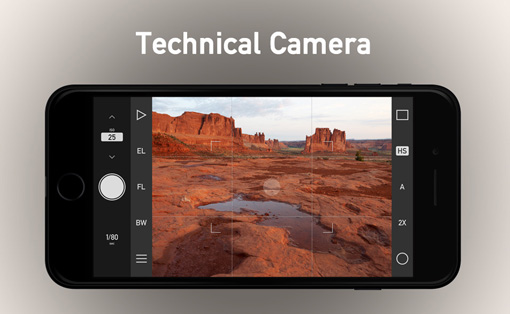
Technical Camera 2.2 Released

The latest update to my Technical Camera app is now available on the App Store.

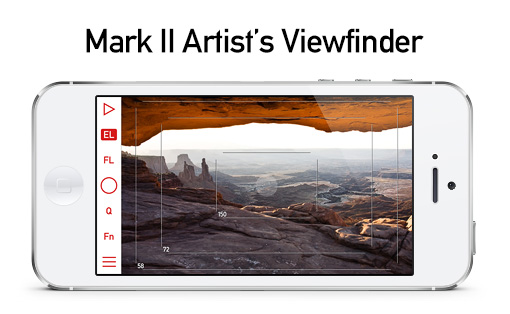
Just like in case of the Mark II Artist’s Viewfinder, it concludes the fall release cycle for the app, adding iOS/iPadOS 16 and new device support.

But there’s more that makes using Technical Camera faster and more efficient.

First, the app now returns to shooting when you switch to it, closing any screens that you may have left open the last time you used the app. This stems from my own usage pattern, where I tend to put the app into the background with an album page open. In the past I subsequently cursed the developer that I have to manually close the damn album when I want to shoot immediately.

But we don’t pull the rug from under your feet – don’t close the screen – when you’re doing any of the following: creating and configuring an album, editing copyright information or navigating with the album’s map.

Second, you can now close camera and screen options by tapping their gray background.

And last but not least, when you are in the album browser, tapping the album’s name lets you change the current album with no need to close the album screen, go into the menu to do the change, and navigate back.

You can check out what’s new this year’s 2.x versions in the release notes.

The update is free for existing users.

Viewfinder 7.2 Concludes the Fall Update Cycle

Each fall Apple releases new devices and operating systems that we have to add support for.
This year was no different, except that iOS/iPadOS 16 has changed some of the fundamental parts of the OS (device rotation support, to be exact), which caused some extra headache. We’ve started to roll out changes in September, and now the app is considered to be complete in this regard.

As you can see in the release notes, new device support was also added to support all models in this year’s iPhone 14 series – both in terms of new screen sizes and camera profiles.

Speaking of the latter, Apple screwed up iOS provided angle of views big time for the Pro phones, but fortunately we don’t trust their data (which is usually off by up to 10-15%) and our profiles are precise as usual.

Sadly, there’s one more iOS bug that you should be aware of when updating any of our apps this fall: the OS may fail to properly close the app before updating it, and subsequently, not knowing which one to run, greets users with a pitch black screen. The fix is quite easy: force quit and restart the app (both copies) to wipe corrupted state information. See our knowledge base article for detailed instructions.

We’ve added support for 20 new cameras this fall, a bunch of lenses, and new aspect ratios that users requested.

The Mark II Artist’s Viewfinder 7.2 update is free for existing users and is available on the App Store.

Improved Wi-Fi Pairing in ShutterCount and Kuuvik Capture

The recently released Kuuvik Capture 6 and ShutterCount 6 brings a very convenient feature for those who use both apps on the same Mac or iOS device with Wi-Fi connection to a Canon camera.

Previously only the Mac’s/iPhone’s/iPad’s name was programmed into the camera’s menu by default, and in case you used multiple wireless tethering apps with the same camera, you had to manually edit the names to be able to distinguish between the apps.

Now we prefix the device’s name with an app identifier. Kuuvik Capture is referred to as “KC”, ShutterCount as “SC” and ShutterCount Pro as “SCP”.

App and device names as programmed into the camera’s menu by our apps.

These names are generated and programmed into the camera’s menu during the pairing process, but as always, you can change them in the camera afterwards.

Kuuvik Capture 6 and ShutterCount 6 are available for your Mac and mobile device in the respective App Store. These updates are free for existing ShutterCount (all versions) and Kuuvik Capture (5.0 or later) customers.

Ultralight Tethering with Kuuvik Capture

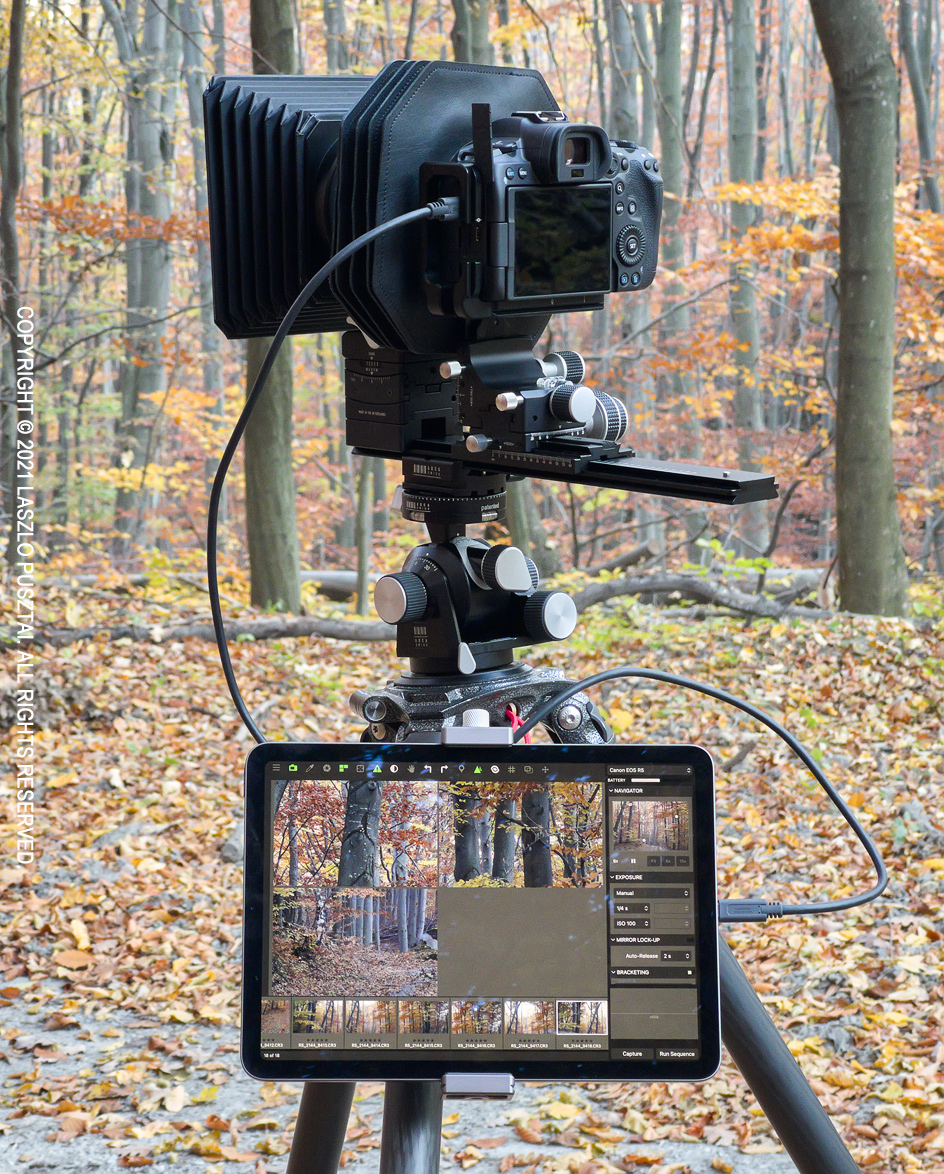
With the release of Kuuvik Capture for iPad, a decade-old dream started to unfold: enjoying all the benefits of tethered shooting out in the field without the burden of carrying around a notebook.

Once the very first beta of the app was ready, a quest for the optimal iPad size and a lightweight mounting solution had begun. It took several weeks of research to arrive at a solution that I’m using for the last year.

My Cambo Actus digital view camera with the Canon EOS R5 acting as the recording medium controlled by Kuuvik Capture running on an iPad Air 4. The image shows one of the app’s unique features: multi-point simultaneous live view.

The iPad had to have a USB-C port and large enough screen while keeping the weight down. Quite early during the development we’ve realized that the sweet spot is the ~11″ size. At the end I chose the Air 4 as it weighs a little less than the Pro, costs less, and for a dedicated tethering controller the Pro doesn’t provide anything worthwhile over it.

Storage-wise 64GB is plenty for me, especially since I don’t have to shoot a myriad of images to compensate for possible errors. With Kuuvik Capture I only keep the perfect ones. 64GB also turned out to be more than enough for a 5-hour Perseid shooting session, where I shot a ton of long exposure images.

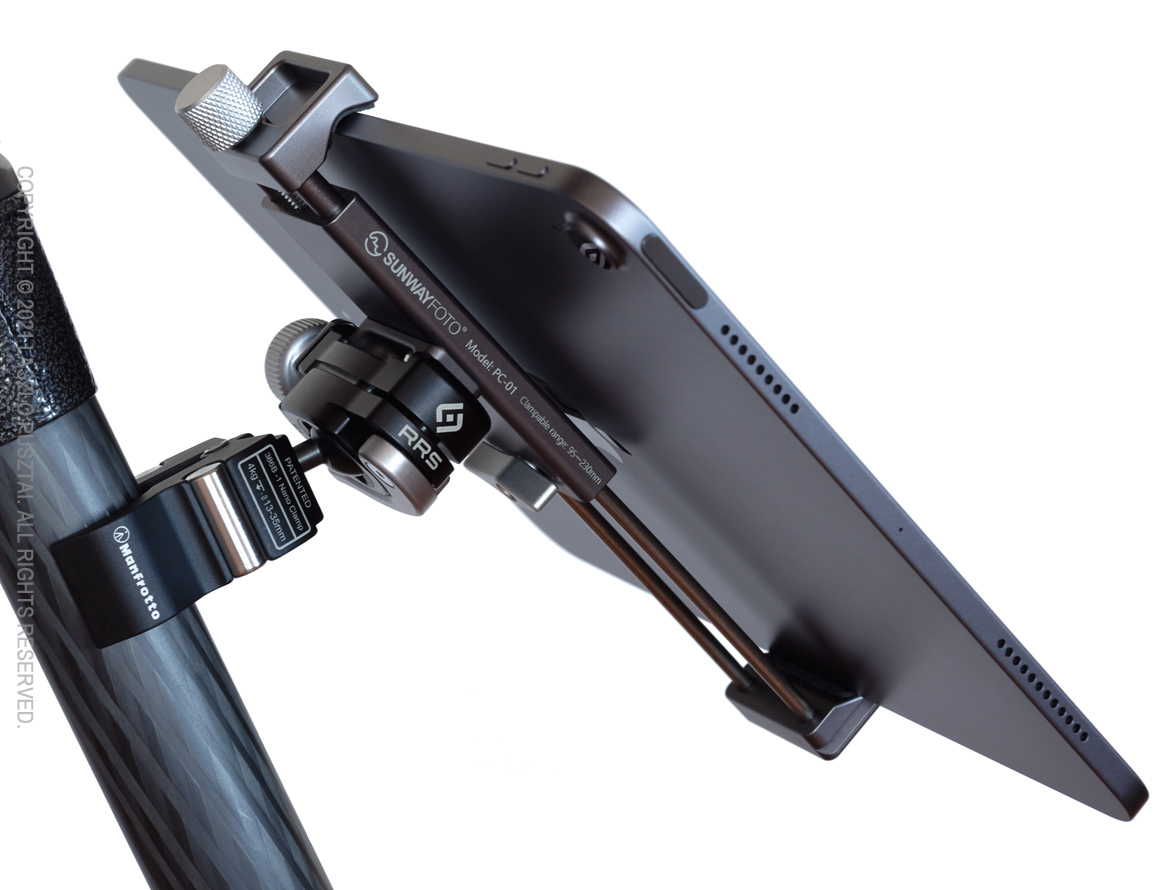
Mounting the iPad was a headache, though. Generally I’m not happy with buying stuff made by Chinese copycats, but it turned out that nobody else makes any competent iPad holder… So I ended up getting a Sunwayfoto PC-01 tablet bracket.

Attaching the iPad bracket to the tripod was an easier job to accomplish with products from reputable European and US manufacturers: my choices being the Manfrotto 386B-1 nano clamp and RRS’ BC-18 micro ball head.

You can see the completed mounting solution below.

The lightweight mounting solution.

The torque the whole iPad assembly exerts on the ball head’s screw is significant, and could easily loosen it from the Manfrotto clamp. So a drop of Vibra-Tite Blue 121 or Loctite Blue 242 removable threadlocker is highly recommended to avoid issues down the road.

You don’t want your iPad to land on a sharp rock after all…

Another possible source of inconvenient moments is the nano clamp itself. If you don’t tighten it enough. Or if it breaks… iPad meets a sharp rock situation again.

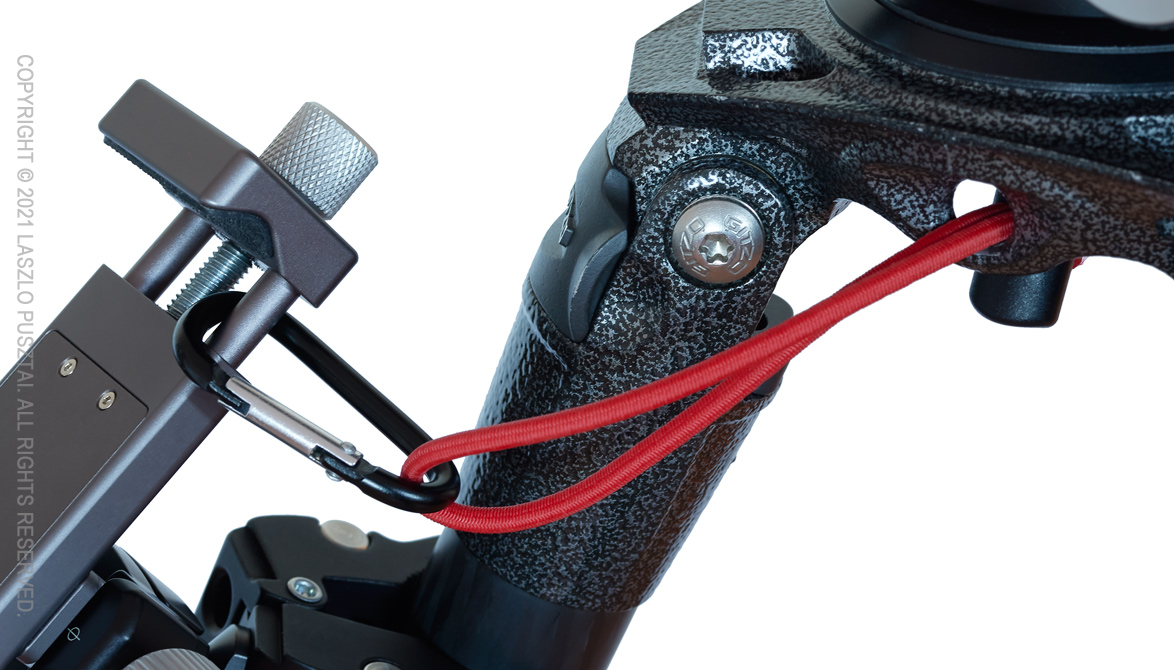
To mitigate this risk, I’m using a simple security tether between the tripod and the iPad bracket.

Security tether.

It is just a Think Tank Red Whip and a small carabiner.

Speaking of tethers, I have to talk about the cables that connect the iPad with my cameras. In plural, since I’m using a 5DS R and a R5 for tethered shooting, both having different USB connectors.

We learned through the years of supporting camera connectivity apps that you should avoid cheap Chinese junk cables and adapters. They are unreliable and most of the time do not work at all. We maintain a list of certified cables and adapters, and can’t stress enough the importance of high quality cabling.

With the R5 I’m using the cable that was included in the box, and with the 5DS R Cable Matter’s 1m long USB-C to Micro B 3.1 cable is my preferred choice.

Why not Wi-Fi? Well, Canon’s Wi-Fi connectivity implementation is a pain to use and is significantly slower than USB. Not to mention that I prefer not to be surrounded by Wi-Fi smog while enjoying nature.

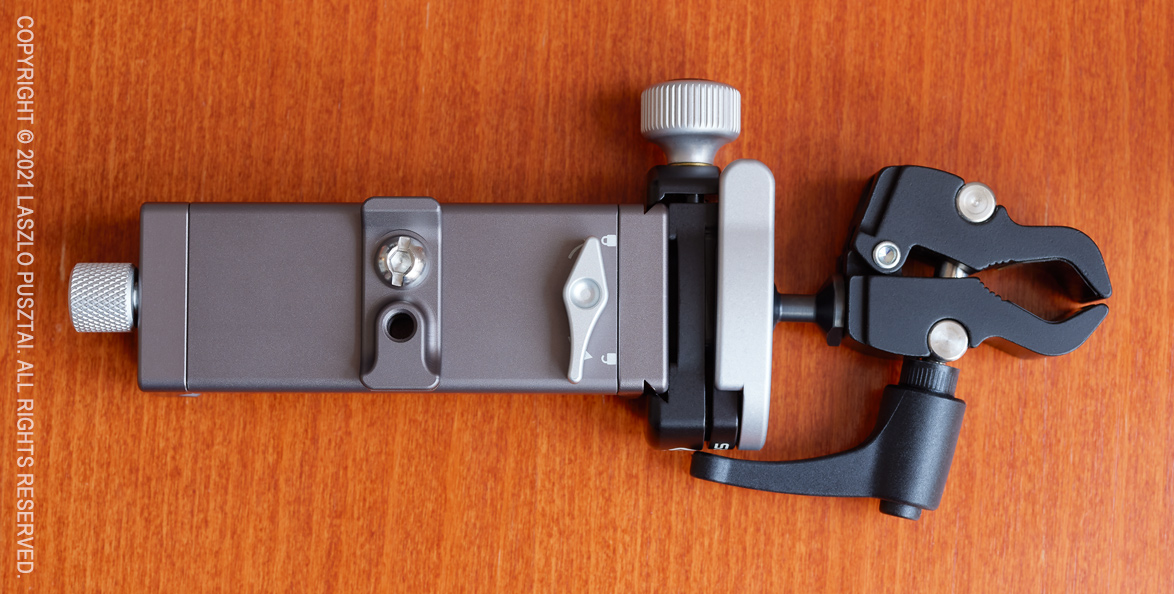
The whole mount packs relatively flat, which I can slip into an outer pocket of my backpack or shooting vest. Even the iPad fits easily into a side pocket of my old Domke vest.

iPad holder and mount packed flat.

How light it is?

The holder and the mount (as shown above) plus the security tether weighs 357 grams. Add 458g for the iPad Air 4 and 83g for the two cables. 898g in total. Not bad for a pro-level tethering solution.

You may have noticed, but I’d like to mention it explicitly: with Kuuvik Capture you don’t need additional boxes, batteries, etc. Just the iPad and a USB cable. Or the camera’s built-in Wi-Fi in case wireless floats your boat.

I’m really happy with this solution, which perfectly augments the app’s ease of use.

Honestly, I feel like I’m cheating when shooting with this rig. It’s so easy to accomplish previously complex tasks, such as obtaining perfect focus with high-megapixel cameras or exposure evaluation. Not to mention the sheer joy of seeing just-captured images on a large screen.

  ☕ ☕ ☕

Did you enjoy this post? Consider buying me a coffee if so.