Technical Camera 2.6 : Ultra Wide Zooming, Camera Button, Highlight Alert

The latest update to our Technical Camera app had been released about a month ago. Besides the usual device support updates (for new iPhones and iPads) and iOS 18 related stuff (dark mode icons and so on), there are a couple of things I’d like to talk about.

Ultra Wide Zooming

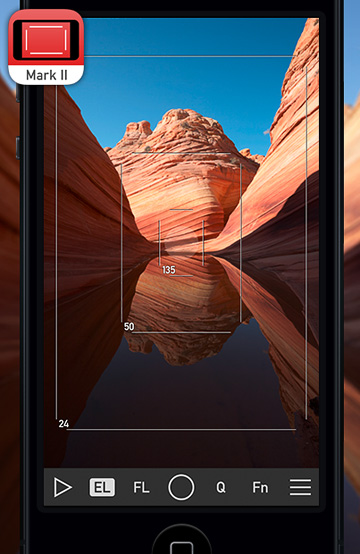
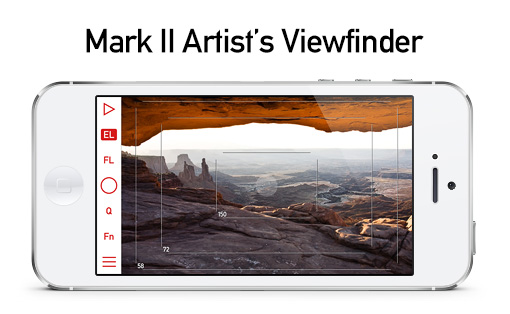
We use our own ultra wide camera distortion correction solution as it is far superior to Apple’s built in correction. For one, it allows precise simulation required in the Mark II Artist’s Viewfinder, and is behind the Framing Previsor in Tech Camera.

There is one limitation with the better correction, however: if the device’s ultra wide camera is way too distorted, then we can’t do the correction when one zooms in.

Fortunately the latest incarnation of Apple’s ultra wide cameras (in the iPhone 14 Pro, 14 Pro Max, 15 Pro, 15 Pro Max, 16, 16 Plus, 16 Pro and 16 Pro Max) are much better in this regard and thus we can do distortion correction when you zoom in.

Given the very short minimum focusing distance of these ultra wide cameras, this makes a formidable macro shooting solution.

Note however, that zooming is only available with JPG captures. For RAWs, you’ll have to crop afterwards manually.

Camera and Action Button Support

iPhone 16 models introduced the Camera button, which I honestly regard as a marketing gimmick. It reminds me of the Canon EOS R’s ill-designed touch bar… Since we have much better user interface solutions for camera control than this, we are not going to support it except for one thing: capturing images.

Speaking of initiating captures with hardware buttons, if you run iOS 17.2 or later, the Action button can also be used for this purpose. The only requirement is that you must assign the “Open Technical Camera” shortcut to it. But with this assignment, the Action button can be used to launch the app, and subsequently take pictures – without lifting your finger from the button. Pretty neat.

Highlight Alert Adjustment

There is a significant step back with recent iOS versions regarding non-HDR captures: the system lowers the dynamic range by about 10%… For no reason… It just stared to happen with newer iOS versions on more and more devices.

So since this is the new norm, we adjusted the highlight alert’s cutoff point to reflect the lower maximum. It’s sad enough that non-HDR dynamic range is reduced by iOS, but at least you can now see where will the system prematurely blow the highlights.

Capture Button Bonuses

One more thing. There are two minor, but nice things regarding the on-screen capture button. First, it has haptic feedback in case you enabled haptic feedback in both the app’s menu and on your phone in general.

Plus, try what happens if you disable Other Sounds in the app’s menu! Yes, you no longer have to put your phone or iPad into silent mode to avoid the ugly iOS shutter sound. Well, unless you live in Japan, where this feature is not available.
Technical Camera 2.2 Released

The latest update to my Technical Camera app is now available on the App Store.

Just like in case of the Mark II Artist’s Viewfinder, it concludes the fall release cycle for the app, adding iOS/iPadOS 16 and new device support.

But there’s more that makes using Technical Camera faster and more efficient.

First, the app now returns to shooting when you switch to it, closing any screens that you may have left open the last time you used the app. This stems from my own usage pattern, where I tend to put the app into the background with an album page open. In the past I subsequently cursed the developer that I have to manually close the damn album when I want to shoot immediately.

But we don’t pull the rug from under your feet – don’t close the screen – when you’re doing any of the following: creating and configuring an album, editing copyright information or navigating with the album’s map.

Second, you can now close camera and screen options by tapping their gray background.

And last but not least, when you are in the album browser, tapping the album’s name lets you change the current album with no need to close the album screen, go into the menu to do the change, and navigate back.

You can check out what’s new this year’s 2.x versions in the release notes.

The update is free for existing users.

iPhone 12 Pro Max Support Added to Artist’s Viewfinder and Technical Camera

Updates to fully support iPhone 12 Pro Max cameras in Mark II Artist’s Viewfinder and Technical Camera are now available on the App Store. This includes both lab-measured angle of views as well as Wide Mode support for the ultra wide camera.

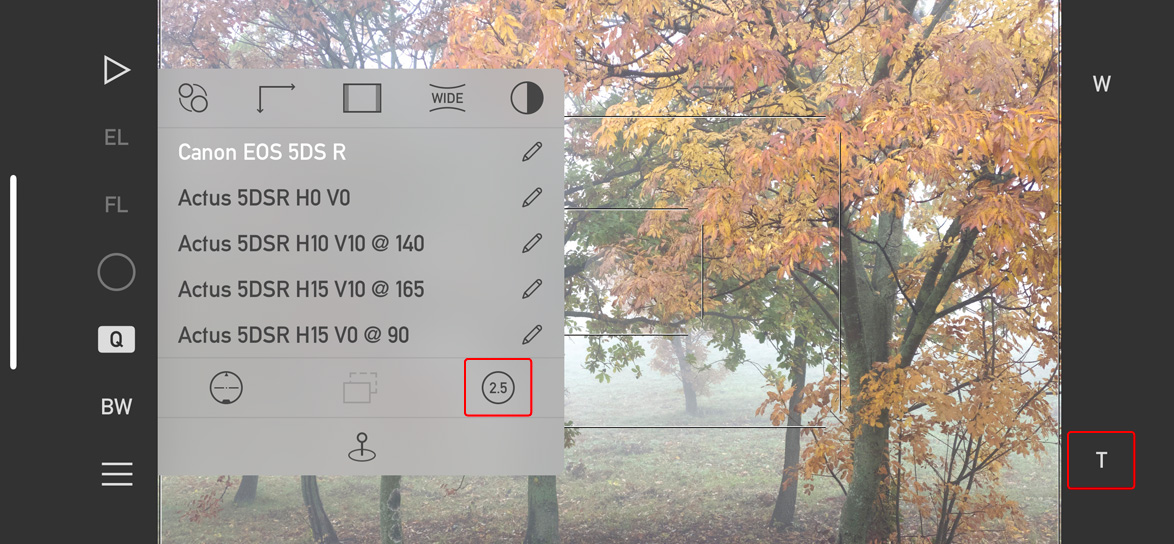
But since the telephoto camera is longer than all other iPhone telephoto cameras were (2.5x vs 2x), the user interface of both apps had to be adapted to the new situation.

Changes in Artist’s Viewfinder to accommodate the 2.5x camera of the 12 Pro Max

The changes are consistent across both apps. First, the 2x icon on the Quick Control Screen in Artists Viewfinder and on Camera Options in Technical Camera changes to 2.5 in case your device sports the longer telephoto camera.

Second, the Smart Function Key formerly known as Switch Wide/Tele Cameras is now named Toggle Telephoto Camera, and the associated key label has been changed from 2x to T to be angle of view neutral. Well, the name change was long overdue since the old one was rather ambiguous on triple camera devices…

The Viewfinder Handbook has also been updated to reflect these changes.

And that’s it for now. Mark II Artist’s Viewfinder 6.8 and Technical Camera 1.9 are free updates for existing users.

First Batch of iPhone 12 Support Updates

Artist’s Viewfinder 6.7 and Technical Camera 1.8 now support three of this year’s four iPhone models: 12, 12 Pro and because it shares its camera system with the regular 12, the 12 mini. Due to camera differences between the 12 Pro and 12 Pro Max, we’ll issue another update once we have a 12 Pro Max in the lab and completed all the measurements.

Compared to 11-series devices, the new camera systems bring both a positive and a negative change. The ultra wide camera has optics that can be corrected more precisely than last year’s, but in exchange the wide camera has more distortion (clearly visible in the corners). You can’t have it all… Other that these, there’s nothing worth mentioning – the ultra wide inherited most of the flaws and limitations of its predecessor (no RAW, no AF, requires software distortion correction).

As usual, we’ve added a few new cameras to the Viewfinder Camera Database, including the Canon C70 and RED KOMODO 6K (for the complete list see the release notes).

iOS 14 Compatibility and Device Support Updates

During the last week we had issued updates to all our apps. These cover compatibility fixes with iOS 14 as well as new iPad and camera support. All apps will work on the new iPad Air, for example.

Bad news first: due to the fact that USB camera control is still completely broken in iOS 14.0.1, we advise Kuuvik Capture and ShutterCount users to defer updating from iOS 13 until Apple fixes the issue. People using only Wi-Fi connections to their cameras are not affected. We’ve added a message when a non-operating USB connection is detected, so you can see whether Apple’s bug affects you.

Update (November 6): The just-released iOS 14.2 finally fixes this bug.

Now the good stuff…

Both Artist’s Viewfinder and Technical Camera was updated with added functionality to be able to use the volume down button as a shutter release, and support the ultra wide camera in this year’s iPad Pro models. Artist’s Viewfinder’s camera database was also expanded with 23 new models.

ShutterCount as well as Kuuvik Capture 5 received a new progress indicator on iOS, displayed when connections take longer than a second. Connections may take a long time if you have numerous images on the memory card, and thus it is a good practice to have an empty card in the camera when using these apps on iPhone or iPad. We’ve also improved Wi-Fi pairing problem detection in all variants and platform versions.

Camera-wise, Canon’s 850D/Rebel T8i is now supported in both apps, and ShutterCount is also certified to work with Nikon’s D780 and Z5. Speaking of cameras, Kuuvik Capture 5 finally gets EOS R5 support!

Since the R5 firmware is still a bug farm, be prepared for some serious limitations. For example, multi-point live view is not available and the snail-fast Wi-Fi is not supported. We are continuously monitoring new firmware versions to see whether these issues are fixed. Honestly, we were waiting for v1.2.0 promised to be released in early September, but since it haven’t materialized yet, we’ve decided to release the app with these limitations.

If you noticed a theme that large companies, such as Apple and Canon, release manure-quality software these days, well, you are not alone…

Kuuvik Capture 5 also got a surprisingly useful new feature on both Mac and iPad: beep when a sequence or a bulb exposure is finished. It is on by default, but can be turned off in the app’s preferences.

These updates are available free of charge for existing users, and can be downloaded from the respective App Store.

Technical Camera 1.6 : Keeping the Lowest ISO

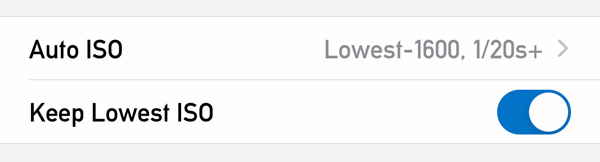
Technical Camera 1.6 introduced a new option, Keep Lowest ISO. But let’s start with a little background information.

Multiple cameras on an iPhone usually have different ISO ranges. For example on the iPhone 11 Pro Max, the ultra wide camera’s ISO range is 21-2010, while the wide camera’s range is 32-3070. The telephoto camera is capable of ISO values identical to the ultra wide.

The difference on the high end of these ranges doesn’t really matter as everything above ISO 400 tends to produce unacceptable results for serious photography, and ISOs above 1600 are pretty much useless.

But the low end is different. You have to use the lowest ISO possible to get the highest image quality. And switching between cameras having a different lowest ISO value in manual ISO mode was a bit of a pain, as you had to adjust the manually set value every time.

This is no longer the case in version 1.6. If you turn the Keep Lowest ISO option on in the menu, the app will automatically set the lowest possible ISO on the camera you switched to, given that you had the lowest ISO set on the camera you’re switching from. Please note that this works only in manual ISO mode. And that’s it. A pretty simple but highly effective feature for those pursuing the highest possible image quality even in mobile photography.