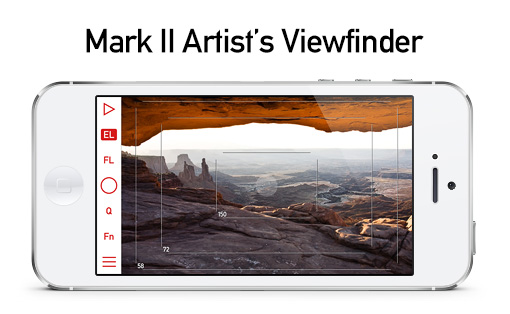
What’s New in the Mark II AVF 3.2 Update

The latest update to the Mark II Artist’s Viewfinder went online earlier today. Besides the usual slew of newly supported cameras and backs (listed in the press release), there are two feature groups I’d like to talk about. Let’s begin with new customization features.

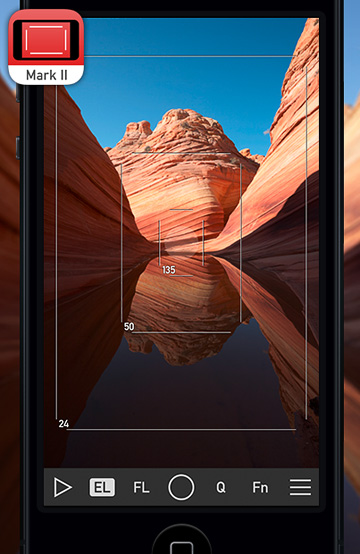
Original Viewfinder editions had a completely neutral main screen. While the Mark II’s red/white toolbar looks pretty neat, a few users complained about the vivid colors interfering with their composition. So in the 3.2 update you can switch the toolbar into a dark and neutral themed one. It’s interesting to note that it brings a completely new character to the main screen – but still looks neat.

dark-toolbar

The new Dark & Neutral toolbar theme

Speaking of distractions, a few of you found the translucent white AF/AE point indicator distracting. You can now turn it off if you wish. But please note that the red circle will still be displayed when AF is in progress.

We also received requests to make “more Fn Keys” – that is to let the user customize the function of other toolbar buttons. And beginning with version 3.2 you can override the EL and FL buttons with the exact same functions that you can assign to the Fn Key. You’ll lose their initial functions while the override is active, of course.

Finally I was able to put my hands on the iPro lens system case for the iPhone 5s, so this update rounds out the supported wide converter/device combinations with both Schneider converters on the iPhone 5s. And also adds the Cambo WRS-1060, which utilizes the Schneider wide lens.

A fix for the “gray screen with no live view after switching to another app and back” bug is also included. While fixing this, I ran into a more serious issue: with toggling exposure lock on and off on the iPhone 5s I was able to bring the phone’s entire video capture system down to its knees. We are working on a fix with Apple, but the interim solutions is to restart live view when you disengage the exposure lock. I know, it’s a bit of pain, but there’s no better workaround yet. The good news is that only the iPhone 5s is affected.

The Viewfinder Handbook has also been updated to cover these new functions.

Thoughts on iDevice Wide Converters

Last week I added support for a bunch of iPhone/iPod wide converter lenses to the upcoming release of our Mark II Artist’s Viewfinder app. They were Schneider’s Series 2 super wide and wide iPro lenses as well as the wide lens in olloclip’s 4-in-1 offering. The picture below shows them: Schneiders on the left, olloclips on the right, and the ALPA ACAM in the middle. They are shown without their mounting cases (except for the olloclips).
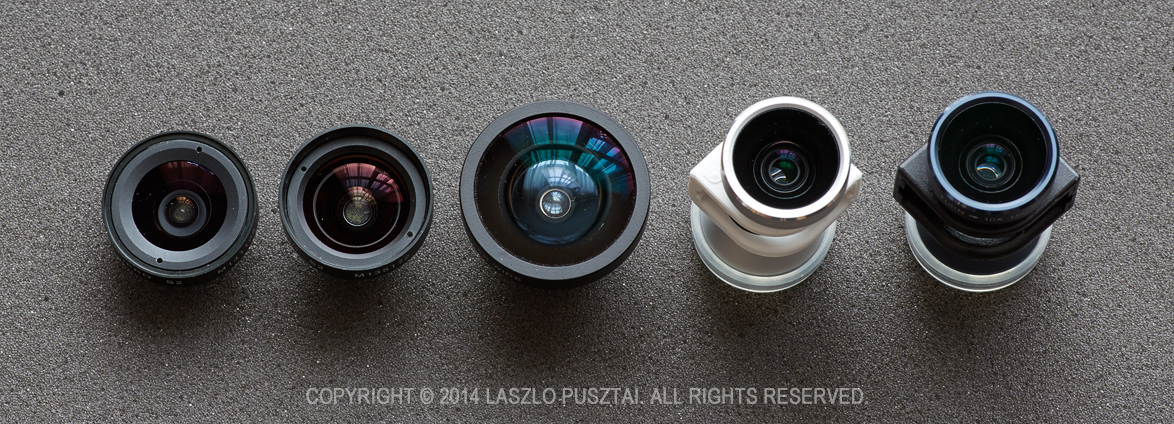
A bunch of wide converters

A bunch of wide converters

While they are all suitable for viewfinder use, you can’t expect good optical performance from such lenses, period. Their manufacturers like to advertise them as “high quality”, “precision”, etc. Well, they might be high quality for someone who lo-fi filters the crap out of their smartphone images, but in my book they are not usable for real photography – even on smartphones.

They are all priced in the same range ($65-$100) with mounting hardware included. Schneiders usually occupying the higher end of this range.

Conversion factor and distortion

The bad news: advertised conversion factors can’t be used to compare these lenses. All super wide converters we measured exhibit huge (10% or more) barrel distortion. What gets in the marketing material is the magnification ratio with no distortion correction applied. That is, they count in the extreme edges, which will result in smaller factors.

But when distortion is removed, those extreme edges go away (as you can see in the first illustration in my previous post). The result: Schneider’s super wide lens that’s advertised as having a 0.45x conversion factor is a 0.5x lens is reality. ALPA’s lens, which is advertised as 0.5x (because I told them to) is a bit wider in reality than Schneider’s 0.45x.

The conversion factor also changes from device to device – and all the adapters I measured go wider when they are used on a device having a wider native field of view. For example, the ALPA is a 0.5x on an iPhone 4, but a 0.48x on an iPhone 5S.
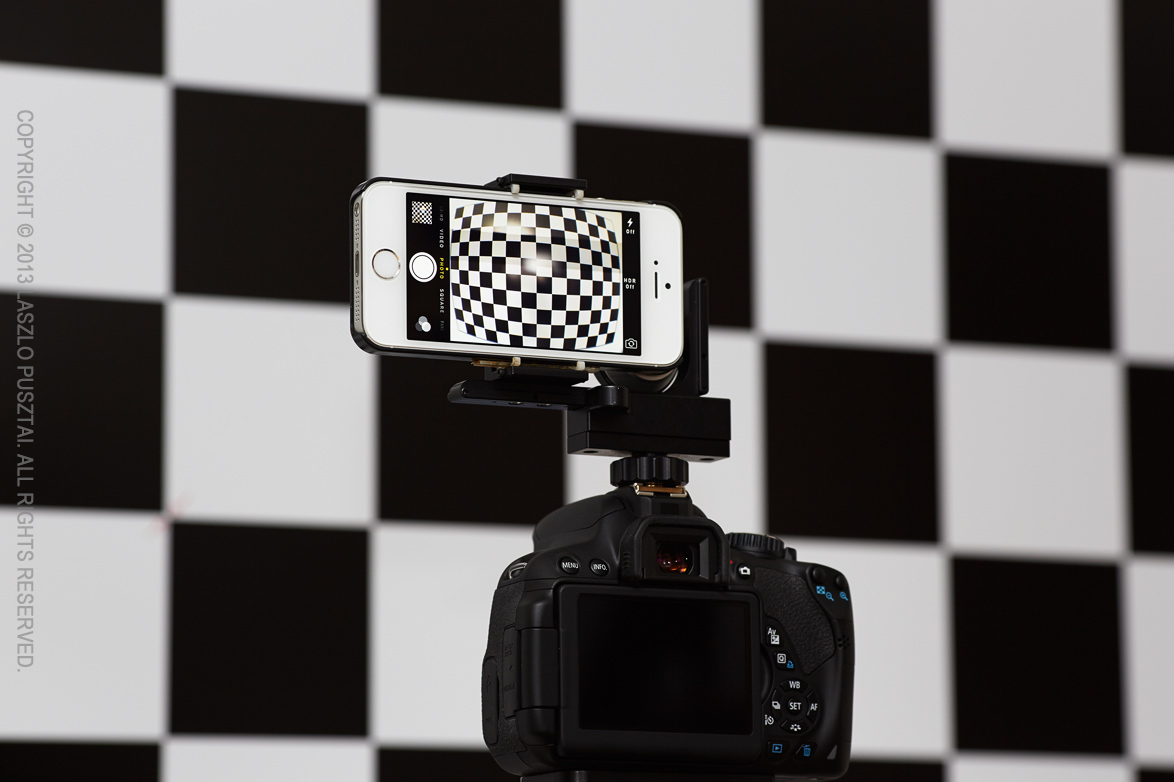
ALPA ACAM mounted for measurement

ALPA ACAM mounted for measurement

If you look at conversion factors you’ll find out that there are two distinct classes: 0.5x and 0.65x. The Schneider super wide and the ALPA wide belongs to the first, and the Schneider wide and the olloclip belongs to the second. Is it important to note that the wide Schneider exhibits only a small amount of barrel distortion – and this lens would be usable even without correction. The olloclip is not, it has the same huge distortion as super-wides.

Sharpness

The sharpest is the Schneider super wide. The least sharp is the iPhone 4/4S variant of the olloclip – so much that I struggled for hours to find the checkerboard corners in the sea of blur and chromatic aberration.

Other aberrations

Schneiders are almost free of chromatic aberration. All others exhibit a huge amount of it in the corners. Centering is bad on all converters. The Schneider super wide also exhibits hard to correct mustache-like distortion. On the iPhone 5 for example this – together with bad centering – causes residual pincushion distortion on one side of the image after the barrel has been removed.

Mounting

Olloclips tend to slip off easily – except when you use it on an iPod, where a rubber inserts keeps the lens in place. Converters with cases are all solid, although I found Schneider’s iPhone 4/4S case too tight and hard to remove.

Mounting on the top of the camera (in the hot shoe for example) is another story. If you want to use the converter lens to compose stitched panoramas with the Mark II, you’ll need a holder that keeps the phone’s lens centered with the camera’s. This is to avoid parallax as much as possible. This is where things start to cost more. ALPA makes a holder that ships with the super wide converter lens and two cases. Other manufacturers, such as Cambo, also make holders (the Cambo includes a converter lens that the Mark II does not support yet). But be prepared to spend $800-$900 on these.

My favorites

I’m not a big fan of the Schneiders. I was confused about which case is compatible with which series lenses, and their site offers little help. Now I know that the series 1 cases can hold series 2 lenses, but not vice versa.

Actually I have two favorites. The ALPA rig (holder and such) is what I use. It offers the widest view, it’s easy to mount on my camera, has the sturdiest lens mount, and so on. All in all, highly recommended.

The other, the olloclip 4-in-1 on an iPod touch 5, was a surprise for me. I never thought how usable this combo could be. It’s lightweight, fast, and the rubber insert keeps the lens from falling. It can simulate lenses down to about 24mm (on full frame 35mm cameras). Not to mention that it’s the cheapest way to get into the wide converter world of the Mark II.

Mark II Artist’s Viewfinder Released

avf2iconI have been silent for the last weeks for a reason: we were working hard to bring the Mark II Artist’s Viewfinder out.
And now I can proudly announce that a few minutes ago it went online on the App Store, so you can go and grab it. :)

The usual announcement stuff will come next week, but you can find most of the info on the app’s microsite right now.

One more thing…

Courtesy of ALPA of Switzerland, the eFinder Tools are now part of the Mark II – no additional in-app purchase necessary. Although the parallax/shift tool is still supports ALPA cameras only, you can freely use the super precise (1/10 of a degree) 3D level with any camera. I might be biased, but for me it leaves the 5D Mark III’s two-axis level in the dust.

Wide Converters in Mark II Artist’s Viewfinder

Today we announced the beta of Mark II Artist’s Viewfinder. With the Mark II we took a new direction on how we handle wide converter lenses. In the past we just multiplied frame line positions with the wide conversion factor, not doing anything about the optical aberrations of the converter lenses. And believe me, they have many. Distortion, chromatic aberration, centering errors, you name it, the converter has it.

Most of these aberrations can be safely ignored as nobody takes real images with a viewfinder. One of them however, distortion to be exact, is a huge problem. It enlarges the center portion of the image and compresses the edges, making the effort of precise frame line positioning futile.

Given the immense power of today’s iPhone GPUs, we set out to get rid of wide converter distortion forever. And I’m pleased to tell you that we succeeded: the Mark II sports real-time distortion correction! Following is an example of its power.

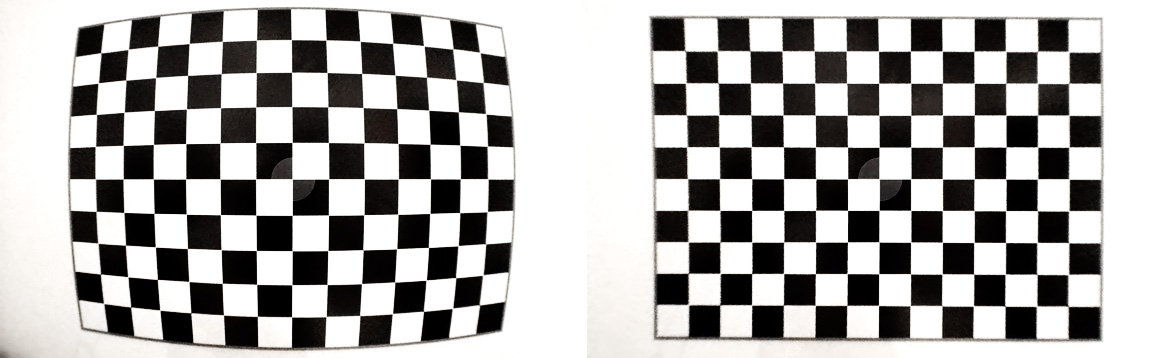
Before and after distortion correction

Before and after distortion correction

ALPA’s ACAM Super Wide Converter exhibits about 11% barrel distortion (on the left). Which is completely eliminated in the Mark II (on the right). Yes, resolution suffers, but it is pretty much enough for viewfinder use. There’s also some darkening on the lower left corner (the converter vignettes heavily and asymmetrically on the iPhone 5s – which isn’t a big issue after the correction).

With the corrected view we can simulate super-wide lenses, which is a blessing for landscape and architecture photography. But I also regularly use the ALPA’s iPhone Holder together with the ACAM SWC as a viewfinder for my Canon TS-E 24 pano stitches. Here’s a screenshot I took on my old iPhone 4 while composing The Circle.

IMG_1631

Composing a stitched pano

Note that the iPhone 4 isn’t fast enough to do the correction at full Retina resolution – all other supported iPhones (4S/5/5S) are.

At launch we’ll support ALPA’s ACAM SWC, but the lab and the measurement technology is ready, and we’ll add adapter/device combinations as we measure them. On the device front, iPhone 4/4S/5/5S are supported.

So if you regularly shoot wide, or want to get a tool that allows you to visualize tilt/shift stitches, then head to the Mark II’s site and sign up for a beta. Seating is limited, so hurry! Then it’s time to order an ACAM SWC from ALPA.

Mark II Artist’s Viewfinder Announced

The worst thing in developing cutting edge software is that you can’t share your excitement the moment you achieved something great. And by the time you can publicly talk about it the excitement is long gone. So this is a special moment for me: talking about an app that’s still in the works, although the major pillars are already in place. And this app is the successor of our Viewfinder family, the Mark II Artist’s Viewfinder.

vf2header2

There isn’t a single piece of code that we haven’t touched during the making of the Mark II. Everything is modernized, made simpler, faster, and better – and have its design updated.

The flat, simple design iOS 7 brought resonates with me deeply. So my goal was to create something that looks every bit as great as it works. I can go on for hours telling stories, and probably will during the coming weeks (just keep in mind that finishing the app is my top priority right now).

For now I’d like to present you a list of what’s new (from the announcement press release):

  • By utilizing the Retina display, frame lines are now 1/3 of their former width. This, along with their increased opacity and contrast, results in drastically improved visibility and reduced interference with the composed shot.
  • The main screen now handles like a camera, complete with auto-exposure lock, auto-focus lock, AF confirmation beep and single shot/continuous AF support. A new Quick Control Screen for accessing frequently needed functions and a customizable Fn Key make the new app more productive.
  • The Mark II can save clean full-resolution photos with location and simulation metadata, so it can be also used as a regular camera.
  • The number of simulated equipment setups (now named “virtual cameras”) was increased from 4 to 20. The number of custom cameras and backs was increased from 5 to 20 each. The number of custom focal lengths per virtual camera was increased from 3 to 20.
  • A new menu system is provided for configuring non-simulation parameters of the app.
  • Track logs can be managed from within the app, with no need to connect to a computer via iTunes File Sharing.
  • Quick Lens Change for quickly modifying the lens list of the active virtual camera.
  • Automatic, configurable length image review (can be also turned off).
  • All features and cameras of the former Pro and Cine editions are now available in a single app, no additional in-app purchases needed

And were are already working on cool things that aren’t even on the list ;)

So make sure to visit and keep an eye on the app’s new microsite, available at: http://www.artistsviewfinder.com.