This post is a quick rundown of my C64 “synthesizer”. I’m not going to go into great length with every part, but will mention the most important things.
Let’s begin with the base of the setup, the brand new C64 Ultimate. Did order it in January, received the unit in mid-June. And I had to immediately repair it. The power LED was improperly connected, and the bar that is responsible for pulling down the left side of the space bar when you press the right side, was dangling around. They were a quick repair, but nevertheless ruined the fun. Not to mention that it took Commodore two weeks to answer my email about these problems.
Build quality of this new Ultimate variant leaves a lot to be desired. Way below my vintage machine. The case’s plastic is thinner, the keyboard flexes like hell, and you’ll strip the screw heads by looking too hard at them.
Luckily, I never planned to keep the ugly brown breadbin case. I always hated it. It’s an ergonomic disaster if you plan to type on it – even for a short time.
So I purchased a white replica C64C case. According to the company that sells it, these are made on original Commodore molds. Well, either Commodore used lesser quality molds towards the end of the C64 life cycle, or this claim is a hyperbole. On the new case you see artifacts on the top case around the screw posts – nothing like this on my vintage C64C. Power LED installation is also completely different: on the original there are two tiny plastic hooks that keep the LED from falling, while on the new one the heads of these hooks are missing, and only friction keeps the LED in.
I did keep the brown keyboard however, as it makes the machine look way cooler than an all-beige thing. The white case helps to mitigate the excrement-like color of the Ultimate keyboard’s function keys. Frankly, whoever made that color lacks taste completely.
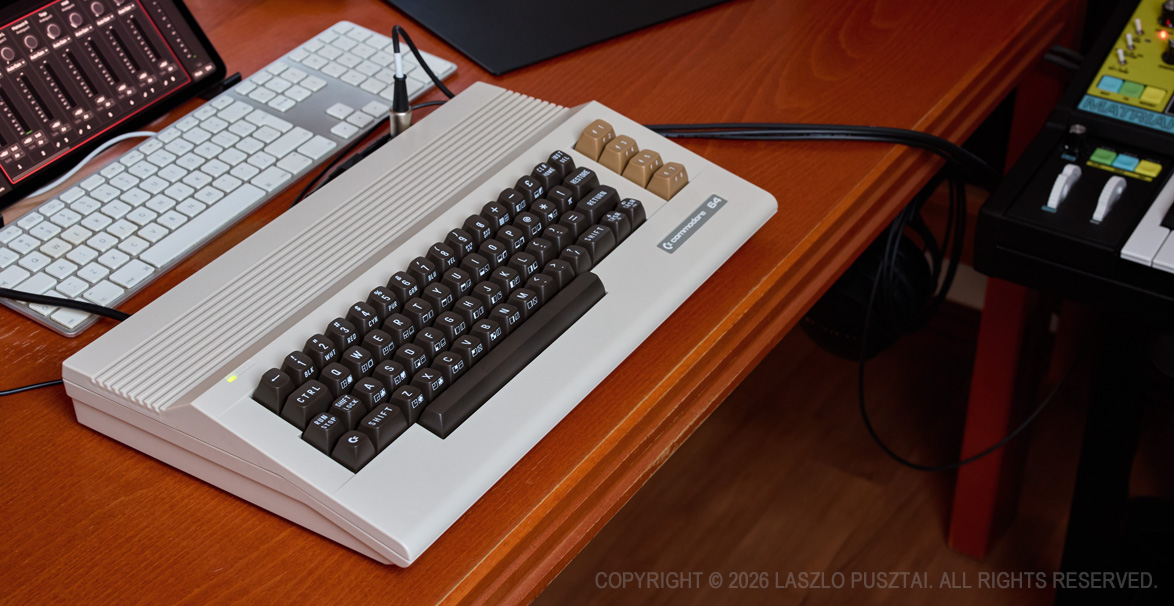
My new Commodore 64 synthesizer
The keyboard in the C case is mounted differently than in the breadbin. Two metal mounting ears keep the keyboard assembly at the proper angle above the mainboard. The ones I purchased with the white case are definitely lesser quality than the vintage ones, but do the job. And this mounting method brings the keyboard’s flex down to an acceptable level. Though I might deploy additional fixes if flexing still turns out to be annoying in the long run.
The Ultimate ships with a power supply having a disgusting, sticky rubber coating on the cable. It immediately went to the electric waste bin. Replaced it with a Moog wall wart, which also has the advantage of providing decently clean power.
I use the machine’s HDMI output for display. It goes into my Blackmagic Ultrastudio 4K Mini. It might be an overkill, but that’s what I already have on my desk. Since the Ultrastudio is a Thunderbolt device, there’s no perceptible latency that you may experience with USB HDMI interfaces. I made a custom app to render the Ultrastudio’s output in the proper aspect ratio – by default it’s pillarboxed, which drove me nuts.
Now onto the synthesizer-related stuff.
I have two 8580 SIDs in the Ultimate board. One is from my vintage C64C, and the other is a new-old-stock chip purchased recently. I bought two of these chips, one is working, the other went back for replacement as it was dead on arrival.
The Ultimate’s flimsy audio output daughterboard had to go. Replaced it with a proper, professional 1/4″ TRS Neutrik jack, along with the reinforcements that prevent the case from cracking when a 1/4″ plug is inserted. The SIDs are connected directly to the 1/4″ jack, bypassing the Ultimate’s digital mixer. Interestingly, the old chip is 3dB louder than the new one. I’m curious what output level the replacement 8580 will provide.
The output jack is wired properly: SID #1 is on the left channel, which is the tip. The original daughterboard connected SID #1 to the ring of its 3.5mm output jack.
I prefer to either make my own cables or buy them from Vovox, and in this case I made one with an angled plug at the C64 side, having the standard insert (or Y or breakout) cable wiring.
The other end of the audio cable goes into the front connectors of one of my Focusrite 18i20 4th Gen audio interfaces. Typically, the old SID needs 9dB gain, while the new needs 12dB.
Synthesizer functionality is provided by a MSSIAH cartridge. The MSSIAH’s user interface may be OK if you want that 1990 feeling, but I’m not going to use it from the C64 that’s 100% sure. It’s simply impossible to accomplish anything swiftly on it. I’m working on something to alleviate this, so you definitely want to keep an eye on my site…
And finally – how it sounds?
It’s fabulous, lovely, and other exaggerated adjectives. It produces exactly that gritty, 8bit, 90s sound I was looking for. And pushing it through my effect chains elevates it to the next level.
Plus, since the two SIDs sound a bit different, you’ll get a nice quasi-stereo sound when playing games.