New ShutterCount Mobile Pairing Videos

We’ve just released two short videos showing the pairing process between a Canon EOS camera and ShutterCount Mobile (actually the Pro edition). I shot these back in last November for the then current version 3.5, but had no time to prepare them for publication until yesterday.

There are slight variations in the pairing depending on which camera model you use, and I have no time to make a video for each and every camera, but the current set covers the vast majority. And once you get the taste of the process, it’s easy to adapt to these differences.

The first video shows the pairing with an EOS M50. It also applies to most contemporary Canons. As you can see, the pairing takes just a minute (and I also do a Wi-Fi reset on the camera, which isn’t needed later on).

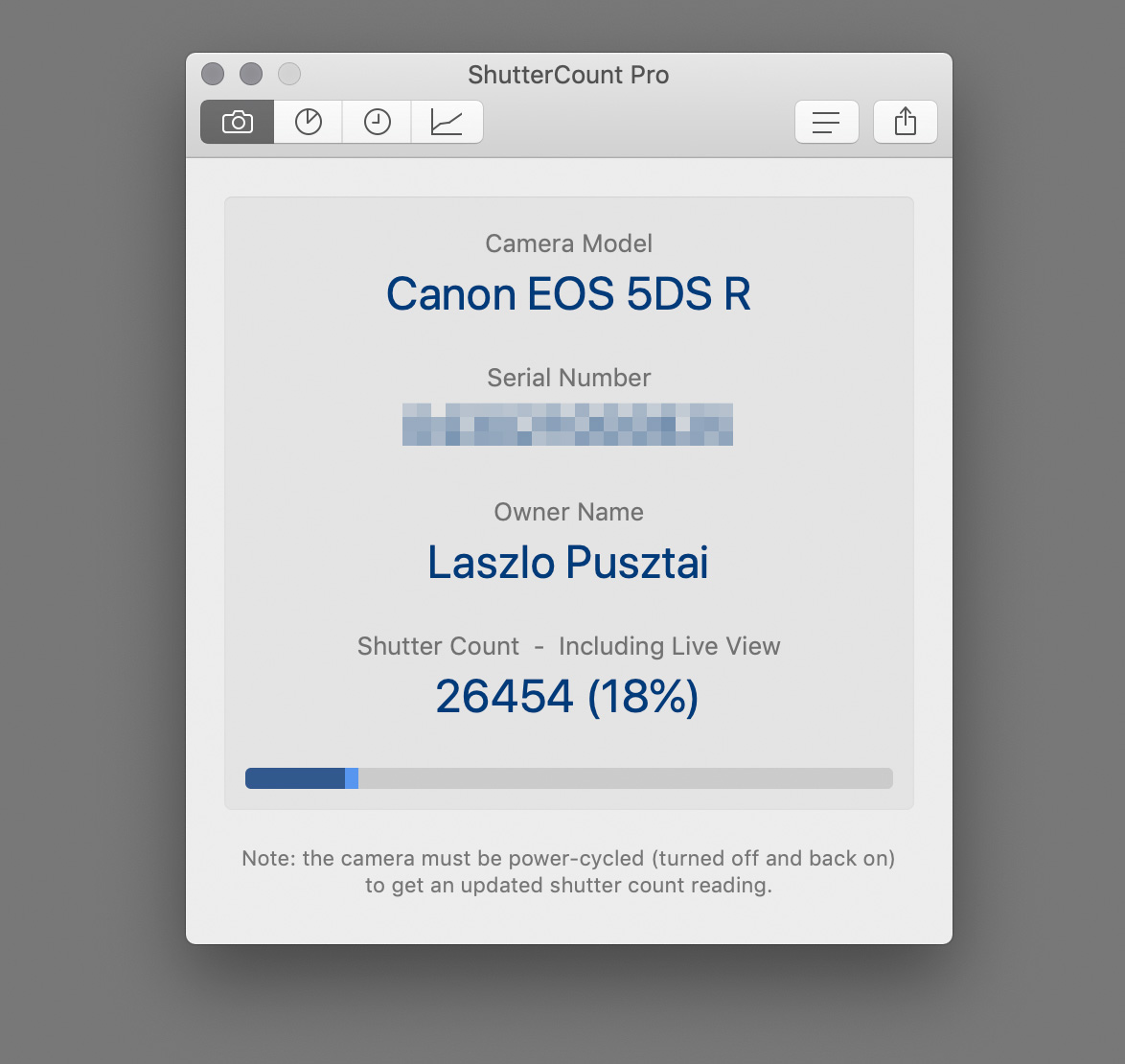
The second one not only walks you through pairing with the EOS 5DS R using the W-E1 card, but also touches other features of the app. This one covers the modus operandi of slightly older Canons.

Yet another variant is covered in an older video, showing the process with the WFT-E7 transmitter and a 7D Mark II.

There’s no sound, because I’m sure you’ll stop the videos a lot while following the process. And sound would just distract.

Hope these videos will make it easier to understand the pairing process. But I strongly recommend to read my former post about the details.

What’s New in ShutterCount 4.0

ShutterCount 4 for both Mac and iPhone/iPad is available now on the respective App Store. This major new release brings a host of under-the hood enhancements that will serve as a basis for exciting new features. But as always, new camera support (EOS RP and new DSLRs) is part of the package.

The first installment of these new feature (owner name editing, the copyright information template and IPTC export/import) is available for users who purchased the Plus Pack or have the Pro edition and is shared with Kuuvik Capture. Please read my former post on them before continuing.

There are a few differences from Kuuvik Capture on a Mac, though. While the copyright information template is available from the Preferences dialog for both apps, owner name editing and IPTC export / import is directly under the Camera menu for ShutterCount (that is, no sub-menu). You can also click the Owner Name title on the Camera Summary tab to edit the owner name.

On iOS things are laid out a bit differently. Owner name editing and IPTC export / import can be found under Camera Settings on the More tab. And the copyright information template editor is also accessible from the More tab, via the Copyright Information item. You can also tap the Owner Name title on the Summary tab as a shortcut for editing the owner name.

As you can see on the screen shot, Prevent Auto Power Off makes an appearance in ShutterCount. Formerly camera connections were terminated when the camara powered itself off. But since you can now edit stuff, it wouldn’t be a great idea to let the camera go (in the worst imaginable moment, of course). So the default is to prevent auto power off. You can disable it if you want to, but we don’t recommend doing so.

Auto power off prevention is available in all editions.

Interference Detection

Canon cameras do not tolerate when multiple apps connect to them, despite the PTP standard would allow it. And instead of a clear error message, they just start to behave erratically. So apps, whose developers believe that every camera manufacturer respects the standard, could inadvertently kick Canon-specific apps in the stomach.

To avoid this, we had a technology to detect interference (that is, when some other app is already connected to and using a camera) since the early days of ShutterCount. Unfortunately Apple decided to kill this technology with the release of macOS 10.12 (and to add insult to injury, introduced a nasty bug in 10.12 that may ruin 5D Mark IV connections – see the end of Q5 in our FAQ).

So we ended up in a situation that’s a nightmare from product support standpoint. This was a high priority issue to solve.

I’m proud to announce that version 4.0 brings back the interference detection on macOS 10.12 and later (ShutterCount on iOS is not affected)! The only difference from the former implementation is that we are no longer able to pinpoint the impostor (the app already using the camera), but can detect the fact that there’s such an app. At the end of the day this is a much better situation, because we at least know for sure that this is the cause of the communication problem and could effectively help people in finding the culprit.

Speaking of these impostors, Photos is number one by far. We already knew it is, and since it pops up a window, it’s something easy to identify. But just hours after the release of 4.0, we got a few support requests complaining about the Another app is also using the camera error message, while there were seemingly no such app running.

Seemingly. You probably don’t know that not all such apps have a visible window. The investigation we carried out after these support requests discovered that the cause is… Dropbox.

Dropbox have a feature that allows you to upload every image when a camera connects. But it locks to all connected cameras regardless if you turn this feature off. This is a major oversight from Dropbox, and we already filed a bug report with them. I’ll let you know how it proceeds. But until they fix it, you should quit Dropbox when you want to use ShutterCount (and the same applies to Kuuvik Capture as well as other camera control apps).

Availability

Version 4 is a free update for existing users on both operating systems. New users can purchase the app in the respective App Store by following links on ShutterCount’s homepage.

ShutterCount Mobile 3.5 : File Mode

Version 3.5 of ShutterCount Mobile (including the Pro edition) brings File Mode to the iOS app.

File Mode is designed to be used with cameras that store the shutter counter in image files, that is almost all Nikon and Pentax models.

While on the Mac it is pretty easy to bring images into the app, it’s a bit tricky on iOS: you have to import them into Photos first. Basically you have two options to do it.

The first is to connect the camera (or a card reader) directly to your iPhone or iPad, and let iOS to import the image into Photos. On this year’s USB-C equipped iPads its straightforward, but on devices with a Lightning connector you’ll need Apple’s Lightning to USB Camera Adapter.

The second option is to import the image into Photos on your desktop computer and let it sync through your iCloud Photo Library to the phone.

Either RAW (NEF/PEF/DNG) or JPG format photos will do it, but I recommend small size JPGs, as the app only needs the metadata from the image, not the pixels.

Other options, such as sending the image through iMessage or via email might strip the metadata portion, in which case the app will tell you that shutter count information is missing from the file.

Once the image is in Photos, open ShutterCount and tap Connect. Tap Open Photo… and the app will let you select the image from your photo library.

If the image is present locally on your device, which is usually the case, especially if you just imported it, the reading will be done immediately.

But if for some reason the photo is in the cloud (because you imported it into the desktop Photos, or if iOS migrated it to the cloud due to low available space on your device), it needs to be downloaded.

For JPGs, Photos will handle the downloading. But for RAW files, Photos will only download the preview JPG, and strip all the metadata we need. In this case ShutterCount will download the complete file for you.
Once the download completed, the app will do the reading.

ShutterCount 3.5 is a free update for existing owners. New users can purchase it in the App Store. Also available is a Pro edition containing all optional extras, such as the Plus Pack with graphing and forecasting features.

File Mode on iOS requires iOS 12 or later and supports the exact same cameras it does on a Mac. For the complete list, please refer to our Tech Specs page.

ShutterCount : Bonjour, les Francophones!

Thanks to Agnes, ShutterCount is now available in French!

This includes both the Mac and iPhone/iPad versions, and regular as well as Pro editions.

If you are using your Mac or iOS device in French as the primary language (or French is before English in your preferred language order), the app will automatically appear in French. Just make sure that you are using version 3.5 (the current one) or later. The update is free for existing users.

À bientôt!

Introducing ShutterCount Pro

We have received numerous requests to make purchasing the whole ShutterCount package (the base app plus the Live View and Plus packs) easier.

Here it goes, the new ShutterCount Pro (for macOS) and ShutterCount Pro Mobile (for iOS) editions contain the complete functionality right out of the box.

That is, you get live view actuation counts and the Distribution Chart (for supported cameras), and all the goodies from the Plus Pack: from graphing and forecasting, to additional niceties, such as Canon camera date/time sync and outdated firmware warning.

If these features sound new to you, then I’d recommend to read my former posts: this one about the Usage Meter and the Graph, and this other one about the Distribution Chart and live view counters in general.

Having purchased the original app, you can make it fully equal to the Pro edition by purchasing the Live View and the Plus packs in ShutterCount’s in-app store.

ShutterCount 3.4 Supports the EOS R

We did it again! Canon introduced a new shutter actuation counter method for its mirrorless cameras, starting with the M50. The just released version of ShutterCount supports this new method, as you can see on the following screen shot.

ShutterCount is the first and only app that can do it.

The new mirrorless counter for my EOS R.

Instead of giving a shot-by-shot counter, the M50 (Kiss M in some markets) and the EOS R will give a value measured in thousands. ShutterCount displays it similar to the 1-series cameras do it in their menu: <= 2000 means the counter is between 1000 and 2000, <= 15000 means the counter is between 14000 and 15000, etc.

The Distribution Chart and live view counters are not available for mirrorless cameras, since all photos are taken in live view mode.

Being Wi-Fi capable, both the EOR R and the M50 are also supported in the iOS version of the app.

Speaking of mirrorless, we also certified the app with the Nikon Z 7. Just like all other Nikons, the Mac version supports this camera via image files.

The Mac version adapts to Dark Mode in macOS 10.14, and the iOS version supports the large screen size of iPhone XS Max and XR.

Version 3.4 is a free update for existing users on both operating systems. New users can purchase the app in the respective App Store. Live View Pack and Plus Pack are available as in-app purchases.