Privacy Issue With Canon Copyright Info Setting

I work with Canon cameras a lot as a developer, and sometimes discover nasty things in their firmware. Most of the time these are just annoyances that delay or block some feature’s availability, but what I recently found may have a serious impact on every Canon EOS camera user’s privacy.

To demonstrate the issue I’ll use my ShutterCount app, which among many other things, can display camera data in question.

The Problem

You are a photographer who cares about intellectual property rights and thus properly set up copyright info in the camera. This consists of four fields: owner name, artist name, copyright and (on newer pro cameras) IPTC info.

Now, you are also privacy-conscious, and delete these before selling a camera to a used equipment dealer. You use the camera’s Delete copyright information menu item, thinking that it will remove everything. Unfortunately this isn’t the case. Besides not touching owner and IPTC fields at all, it only replaces the very first character of the author name and copyright fields with a zero, leaving your previously set copyright information in the camera.

ShutterCount‘s new Raw Copyright Information feature reveals deleted data.

Moreover, setting a shorter-than-previous author or copyright using the camera’s menu will just overwrite the newly entered characters, leaving part of the previous longer text unmodified.

Red characters mark the leftover, black characters are legitimate, currently active text. Zero memory values are displayed as spaces for better legibility.
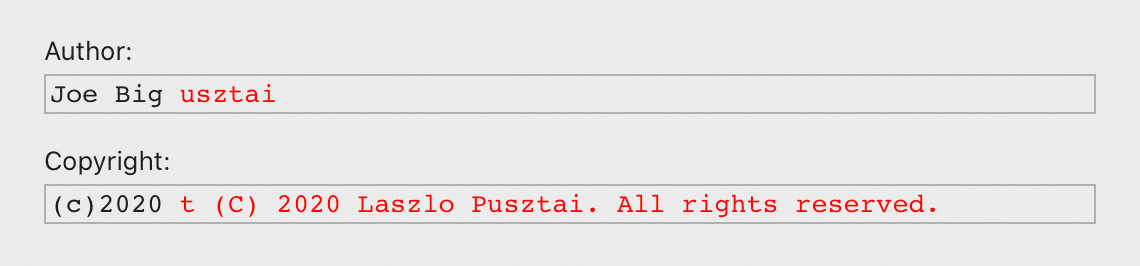
Leftover after setting shorter text in-camera.

The remote control interface is also affected. Using EOS Utility (and possibly many other remote control apps) will fill the remainder of these fields with arbitrary memory contents of the camera. Actually this is what triggered my research into the issue: I saw part of my address from the IPTC info in the author field.
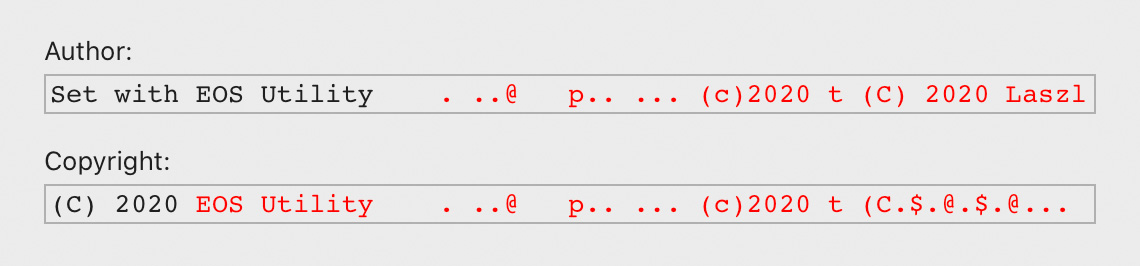
The garbage EOS Utility leaves. Note parts of the previous values!

As far as I know, this behavior is exhibited by every single Canon EOS digital camera model announced since 2007.

Consequences

Your identity may be exposed to anyone who buys your camera through a used equipment dealer. I don’t know about you, but the idea that some camera-illiterate idiot will bug me after buying my old camera through a shop makes me uncomfortable.

Or worse, your long-sold camera may be found on a crime scene, and CSI finds the copyright info that accuses you being connected with the crime. Creepy, isn’t it?

Yeah, private information leaks are creepy. But this bug is double-edged sword, and may be terribly useful every once in a while.

Suppose your camera was stolen, and the thief deleted your copyright with the aforementioned menu command. Law enforcement will be able to reveal that it actually belongs to you.

Used equipment dealers may also benefit from it, being able to double-check the camera’s owner.

Mitigation

There’s a zero-cost method, which takes some time, but there’s also an automated method, which costs a few bucks.

The zero-cost method is to first delete both the owner and and IPTC info with EOS Utility, then go into the camera’s menu and completely fill the author and copyright fields with spaces, or X characters (or anything you would like), and save them. Then use the Delete copyright information menu item.

If you prefer the automated method, ShutterCount‘s Wipe Personal Data command will securely wipe all ownership and copyright information from the camera. This feature is available in the Pro version, or after you purchased the Plus Plack in the regular version.

I’d like to mention that the Copyright Information Template in both my ShutterCount and Kuuvik Capture apps will set the author and copyright fields properly, removing any previous leftover.

Ultimately I hope Canon will step up and address this issue by properly zero-padding the author and copyright fields, regardless of whether they were set in-camera, or remotely.

Exploiting It for Good Purposes

As you know by now, ShutterCount can reveal the extraneous information contained in the author and copyright fields, and can be used by anyone who has a reason to peek into that. It displays the dialog box what you see on the screen shot above.

I’m sure used camera shops and law enforcement agencies will find this feature rather useful. And hope that camera shop personnel will go through their used assets now, wiping personal data from every single one of them as a courtesy to previous owners.

The mentioned features are available in ShutterCount 4.7 or later. The Raw Copyright Information and Wipe Personal Data commands are on the Camera menu on macOS and under Camera Settings on the More tab on iOS.

iOS 14 Compatibility and Device Support Updates

During the last week we had issued updates to all our apps. These cover compatibility fixes with iOS 14 as well as new iPad and camera support. All apps will work on the new iPad Air, for example.

Bad news first: due to the fact that USB camera control is still completely broken in iOS 14.0.1, we advise Kuuvik Capture and ShutterCount users to defer updating from iOS 13 until Apple fixes the issue. People using only Wi-Fi connections to their cameras are not affected. We’ve added a message when a non-operating USB connection is detected, so you can see whether Apple’s bug affects you.

Update (November 6): The just-released iOS 14.2 finally fixes this bug.

Now the good stuff…

Both Artist’s Viewfinder and Technical Camera was updated with added functionality to be able to use the volume down button as a shutter release, and support the ultra wide camera in this year’s iPad Pro models. Artist’s Viewfinder’s camera database was also expanded with 23 new models.

ShutterCount as well as Kuuvik Capture 5 received a new progress indicator on iOS, displayed when connections take longer than a second. Connections may take a long time if you have numerous images on the memory card, and thus it is a good practice to have an empty card in the camera when using these apps on iPhone or iPad. We’ve also improved Wi-Fi pairing problem detection in all variants and platform versions.

Camera-wise, Canon’s 850D/Rebel T8i is now supported in both apps, and ShutterCount is also certified to work with Nikon’s D780 and Z5. Speaking of cameras, Kuuvik Capture 5 finally gets EOS R5 support!

Since the R5 firmware is still a bug farm, be prepared for some serious limitations. For example, multi-point live view is not available and the snail-fast Wi-Fi is not supported. We are continuously monitoring new firmware versions to see whether these issues are fixed. Honestly, we were waiting for v1.2.0 promised to be released in early September, but since it haven’t materialized yet, we’ve decided to release the app with these limitations.

If you noticed a theme that large companies, such as Apple and Canon, release manure-quality software these days, well, you are not alone…

Kuuvik Capture 5 also got a surprisingly useful new feature on both Mac and iPad: beep when a sequence or a bulb exposure is finished. It is on by default, but can be turned off in the app’s preferences.

These updates are available free of charge for existing users, and can be downloaded from the respective App Store.

iOS 14 Breaks USB Tethering

WARNING: iOS and iPadOS 14 that is going to be released later today completely breaks USB camera remote control on iPad and iPhone.

Customers relying on USB connections for Kuuvik Capture and ShutterCount Mobile MUST NOT upgrade to iOS 14.

We had reported the problem to Apple on July 23, and it is still not yet resolved as of today despite our numerous attempts to get Apple to fix it. I will not add further comments right now, I think the facts speak for themselves, but I’m not amused. Not remotely amused.

Update (October 2): Apple confirmed that this is a bug in iOS 14, with no workaround, and they “anticipate a fix getting included in an upcoming iOS release”. Stay tuned.

Update (November 6): The just-released iOS 14.2 fixes the bug.

ShutterCount 4.5 Released with EOS R5 Support

The latest update to my ShutterCount app is now available for both Mac and iOS on the respective App Store. The headline feature is Canon EOS R5 support.

Since the app supports Wi-Fi connections in EOS Utility (Remote control) mode, it’s time to bring another gross R5 fault to the spotlight: glacially slow Wi-Fi connections.

Normally a Canon EOS camera would establish a Wi-Fi connection in a second or two, but for the R5 it may take 40-60 seconds. The same happens with Canon’s own EOS Utility 3 software, just its badly designed, slow-to-operate user interface covers most of this time. Slowness kicks in after the last step of the pairing is done on the camera, as well as in case of all subsequent connections. So if you must use Wi-Fi, then be prepared to brew a coffee while the camera connects. This is one of the many R5 bugs that Canon should urgently fix with a firmware update, but for now I would recommend to forget Wi-Fi and use USB instead – it works even on iOS. Update: firmware 1.1.0 is still unusable for Wi-Fi.

Speaking of bugs, we’ve fixed a crash that could happen when IPTC information is set to a camera having no IPTC set before, and another one in the iOS version’s copyright info template editor.

With this release the iOS version gains a few new features. History logs can be accessed via the Files app on both iPhone and iPad, and ShutterCount now fully supports slide over and side-by-side multitasking on iPads. The latter is a great way to have the app and the Getting Started Guide open side-by-side while you’re doing your very first Wi-Fi pairing, for example.

To use USB tethering on iPhone and iPad, iOS/iPadOS 13.4 or later is required. During the last couple of months we’ve received a few support requests complaining about non-working USB tethering. The cause in all cases was the cheap aftermarket Lightning to USB or USB C-to-A adapter the customer tried to use. We continue to recommend only Apple’s adapters as well as Apple, Canon or TetherTools USB cables.

The version 4.5 update is free for existing users.

ShutterCount 4.4 Brings USB Connections to iOS

The history of my ShutterCount app is a story full of world’s firsts. Just to mention the most important innovations:

  • October, 2013: The world’s first Canon shutter count reader on macOS.
  • April, 2016: The world’s first Canon shutter count reader on iOS (for Wi-Fi equipped cameras).
  • June, 2017: The world’s first shutter count reader on Mac and iOS that supports post-2014 Canon cameras and that introduces live view counters and the Distribution Chart.
  • October, 2018: The world’s first shutter count reader that supports Canon mirrorless models.
  • March, 2020: The world’s first shutter count reader that supports Canon cameras via USB connection on iOS.

The complicated Canon Wi-Fi pairing interface was always a problem for users of the mobile app. I’ve written a long guide and produced a few videos that allowed lots of people to successfully navigate this mess. But what I always wanted was proper USB support on iOS.

Last fall, with the release of iOS 13.1, Apple partly delivered my requested feature. USB tethering appeared in the OS, but was completely defunct. We’ve provided extensive feedback to Apple during the last six months, and now finally have an OS where USB tethering works reliably. I have only one gripe (with permission prompts) that I’ll discuss shortly.

How Does It Work?

First, you’ll have to have a USB port on your iOS device. New iPad Pros have a USB-C port, that’s fine (although you may need a USB-C to A adapter if your camera doesn’t have a C-type port). But for all devices having a Lightning port, Apple’s Lightning to USB 3 Camera Adapter, or the former USB 2 version, will be a required accessory.

ShutterCount USB connection on iOS

The above image shows a typical setup, with my good old 7D Mark II hooked up to an iPhone 7 Plus using the Canon-provided USB cable and Apple’s adapter.

Once the camera is connected and turned on, you’ll be greeted with a series of permission prompts. These prompts are presented by iOS (not ShutterCount), in a very un-Apple-ish manner (three prompts for a single thing).

The first two ask for Files and Folders and Camera access permissions. As I mentioned regarding Catalina’s similar approach, this is not just terrible user experience, but also a security issue as you’ll have to grant much broader permissions than it would be necessary. An example of Apple ignoring its own guidelines…

And to add insult to injury, there’s the third prompt, which will appear every single time you connect a camera. This is a rather ridiculous one: it tells you what you already know, and you don’t have an option to block access (tapping Settings will bring up Settings, but the connection will succeed). I’ve already called out Apple multiple times to fix the permission mess around tethering – nothing happened yet.

So please don’t blame us for this thing. But I do encourage you to provide feedback to Apple. The more of us complain, the more pressure on Apple to make this right.

New Camera Support and Availability

Speaking of new cameras, we’ve added support for Canon’s new EOS-1D X Mark III in both the Mac and iOS versions.

ShutterCount 4.4 is available now on the respective App Store. To use USB tethering, iOS 13.4 is required, which Apple promises to release on Tuesday.

The update is free for existing users.

ShutterCount 4.3 Released

The latest update to my ShutterCount app is now available on the iOS and Mac App Stores.

Camera-wise, this release brings Canon EOS M6 Mark II and EOS Ra support.

Apple totally messed up tethering with macOS Catalina 10.15.2, so we added extensive in-app guidance about what (seemingly unrelated) permissions you have to grant to ensure that macOS lets the app communicate with USB connected cameras. Failure to do so will prevent the app from doing its job.

And there are revised icons for Pro editions on both platforms.

The update is free for existing users on both iOS and macOS. New users can purchase the app in the respective App Store.

Enjoy, and have a happy new year!